Despite the early start and the short shipping window, industry says crop is much improved on problematic 2025 harvest
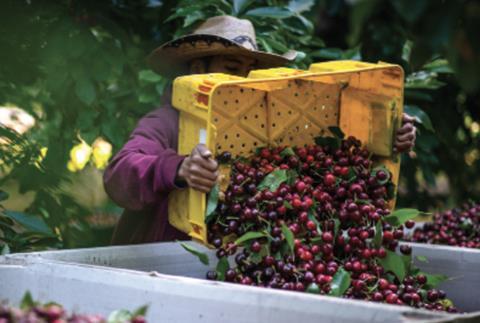
In the months leading up to the 2026 California cherry season, growers in the San Joaquin Valley were hoping for a substantial improvement over the difficulties of the previous season. The 2025 campaign was an ordeal from start to finish as production plunged by 50 per cent to less than 5mn cartons (8.2kg) after averaging 9.8mn over the prior two years. For an industry struggling with vastly increased costs of production over the last many seasons, the lack of volume was disastrous.
While yields appear to have improved, the 2026 season is likely to be a complicated one. The source of concern is California’s increasingly volatile weather. According to the U.S. National Weather Service, March 2026 was the hottest on record across the San Joaquin Valley, where the majority of the state’s cherries are grown. The extreme heat brought on an almost simultaneous bloom in the orchards throughout the valley, leading to the earliest start of a season in more than a decade. Due to the compressed bloom, it is expected that virtually all of the California crop will ripen during May, forcing the industry to market its fruit in a matter of weeks instead of months. Only three seasons ago, the California industry was still harvesting cherries through to early July.
“The (cherry) deal will be fast and short-lived this year,” noted Stemilt Grower’s Dave Martin in early April. “Some guys are planning to start around 10 April due to a rain threat but most everyone will be well underway by 20 April with full production by the first week of May.”
Martin expects the majority of the 2026 crop will be harvested between 6 May and 20 May, with production falling off drastically thereafter.
“Once the harvest starts in Kern County (south), we’ll likely see fruit getting picked in Stockton (north) the following week,” predicted Mark Calder of Primavera Marketing. “Because this crop is so compressed, there’s a real concern whether the industry has enough labour to pick fruit when it’s ready, as well as enough capacity to pack and store it.”
According to California Cherry Board statistics, the first shipments of the 2026 season occurred on 14 April in advance of a vigorous spring storm. Due to the early maturity, growers are understandably concerned over potential damage to their crops from rain and potentially hail.
“Normally, an early- to mid-April rain is not a big problem,” said Jim Hanson of Grower Direct Marketing. “But with this crop so advanced, there are bound to be some quality problems here and there.”
Hanson noted that the industry is concerned about another rain event forecasted to arrive toward the end of the month.
“Although this new storm is not expected to be as strong, the cherries are already saturated so there is a real risk of (fruit) cracking.”
Barring any significant damage, the industry believes it has a quality crop on its hands and one that is much improved over the problematic 2025 season.
“Despite the early start and the short shipping window, this is a very promotable crop,” said Hanson. “While it’s probably not as much volume as some originally thought, there’s going to be ample supplies for both Mother’s Day and Memorial Day promotions, which is rare!”
California’s cherries will likely end up being quite expensive for Asia-Pacific consumers this year, however, due to the strength of the US dollar and soaring air freight rates arising from the Iran conflict .
On a positive note, there is expected to be very little overlap with production from the Pacific Northwest this year since there are reports of damage to fruit in the early districts in Washington resulting from a late spring frost.
This article appears in the upcoming edition of Asiafruit Magazine, for more coverage on the global cherry market sibscribe HERE.