New rules set out phased increases in preferential import quotas from 2027, with tariffs cut to 25 per cent for apples and zero for kiwifruit
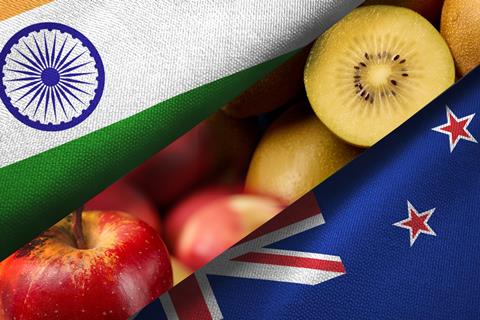
India has confirmed its annual import quotas and tariff arrangements for New Zealand apples and kiwifruit, under the countries newly forged free trade agreement (FTA), which is due to enter into force on 20 October.
In a public notice issued dated 17 October, India’s Directorate General of Foreign Trade (DGFT) set out the tariff-rate quotas that will govern preferential imports of each product, including applicable duties, minimum import prices, seasonal windows, and procedures for allocating import authorisations.
Crucially, neither product will receive a preferential quota this year. The first allocations will be available in 2027, with 35,000 tonnes of apples eligible for a reduced tariff of 25 per cent, and 8,000 tonnes of kiwifruit qualifying for duty-free entry.
Under the new arrangements, New Zealand’s annual apple quota will increase from 35,000 tonnes in 2027 to 37,500 tonnes in 2028, 40,000 tonnes in 2029, and 42,500 tonnes in 2030, before it settles at 45,000 tonnes from 2031 onwards.
Apples imported within the quota will be subject to a 25 per cent tariff, compared with the existing 50 per cent duty – provided their cost, insurance, and freight (CIF) value is at least US$1.25/kg.
These preferential arrangements will apply during a seasonal import window that runs from 1 April to 31 August each year. Shipments outside the quota will remain subject to the standard import duty.
For kiwifruit, meanwhile, the annual duty-free quota begins at 8,000 tonnes in 2027 and rises to 9,750 tonnes in 2028, 11,500 tonnes in 2029, and 13,250 tonnes in 2030, before it levels out at 15,000 tonnes in 2031.
To qualify for zero-duty entry, kiwifruit shipments must have a CIF value of at least US$1.80/kg and arrive during the annual quota window of 1 April to 15 October.
Outside the duty-free quota, Fruitnet understands that qualifying New Zealand kiwifruit will benefit from a separate concession reducing India’s basic customs duty to 15 per cent, provided shipments have a CIF value of at least US$2.50/kg.
Unlike the duty-free quota, which will first become available in 2027, this concession takes effect when the FTA enters into force on 20 October.
Ready from 2027
The latest notification clarifies an important detail of the agreement’s implementation. Earlier announcements had envisaged first-year quotas of 32,500 tonnes for apples and 6,250 tonnes for kiwifruit.
But the DGFT notice defines the agreement’s first year as 20 October until 31 December 2026, and with both import windows already closed, quotas are set to zero for that period.
The department also confirmed how the quotas will be administered, clarifying that New Zealand will be responsible for allocating quota entitlements to exporters or producers and issuing export certificates that specify the product, permitted volume, and designated Indian importer.
The relevant New Zealand authority will also communicate these allocations to DGFT. Indian importers will then apply for corresponding quota authorisations.
As Fruitnet reported when negotiations concluded, the deal represents a significant breakthrough for New Zealand’s apple and kiwifruit industries, which have faced substantial tariff barriers when exporting to India.
Beyond apples and kiwifruit, the FTA provides for the progressive elimination of tariffs on New Zealand cherries, avocados, persimmons and blueberries over ten years.
Tariffs on apricots and pears will also be halved over five and ten years respectively.
In July, Zespri chief executive Jason Te Brake outlined his ambition to make India the company’s fifth-largest kiwifruit market, behind Europe, China, Japan and the US.