Production could reach 1.15mn tonnes in 2025/26, with improved fruit health and export recovery on the cards
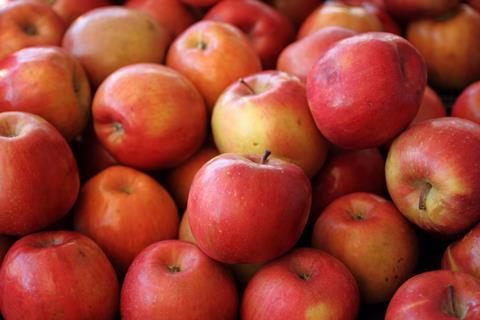
Brazil is anticipating a larger and healthier apple crop for 2025/26, with production set to weigh in at between 1.05mn and 1.15mn tonnes, according to the Brazilian Apple Producers Association (ABPM).
It said climatic conditions have produced a high-quality crop, with excellent colouration, juiciness, and a balance between sugar and acidity.
The forecast marks a significant recovery from last season, when excessive rainfall caused a sharp decline in output and the total harvest reached just 420,000 tonnes.
“This harvest signals a return to volumes closer to normal, with an important quality differential. We have apples with excellent visual standards, balanced flavour, and a high level of technology in the field, which strengthens Brazil’s competitiveness,” said Francisco Schio, president of the ABPM.
Exports are expected to hit 60,000 tonnes in 2025/26, 40,000 tonnes of which will come from Rio Grande do Sul and the remainder from Santa Catarina. Brazilian apples reach 20 countries, including India, Portugal, Ireland, the UAE, Russia, the UK, Bangladesh, the Netherlands, and Saudi Arabia amongst others.
Speaking to Mas Producción, ABPM’s director, Nicolás Pérès, said the 2025/26 crop heralds a notable improvement in quality with fewer fungal diseases. However, he warned that the weather is set to once again play a decisive role and that projections remain fragile. The growing season was marked by a prolonged period of drought that has impacted fruit development, especially in early varieties.
Rains in the Fraiburgo region – one of the most important apple producing regions – have brought some relief in recent weeks. It also rained in Rio Grande do Sul, although to a lesser extent, as well as in São Joaquim.
“My personal opinion is that [the rains] are a bit late for the Gala variety,” Pérès told Mas Producción. With between 10 per cent and 15 per cent of the Gala crop already harvested, much of that fruit will not benefit from the recent precipitation. He predicts that final harvest might eventually gain some size thanks to the recovered soil moisture, but the impact will be limited.
However, in Fuji – a later-ripening variety that stays on the tree longer – Pérès said the recent rains could partially offset the effects of the initial drought, provide weather conditions remain stable in the coming weeks.
Although the forecast marks and improvement on last year, Pérès noted that it is still well below Brazil’s productive potential. He said a “good” harvest starts at 1.2mn tonnes, while volumes in a full season without any adverse weather conditions could reach as much as 1.5mn tonnes.
However, he warned that this figure is no longer attainable due to the effects of climate change and the ensuing droughts, unseasonal heavy rains, and temperature variability.
On the plus side, the drought has had a positive impact on crop health. “This year we didn’t have any problems with glomerella due to the lack of rain,” Pérès stated, adding that the lack of rainfall during critical periods reduced the incidence of this disease, as well as other traditional fungal diseases in Brazil, such as scab.
There was also no significant presence of russeting – the surface roughness that devalues fruit in the most demanding markets. “The fruit is very smooth, which increases the quantity that goes to the packing plant,” Pérès said.
In practical terms, this means a higher proportion of exportable commercial-quality fruit and less waste.
The drought has affected the average size of the fruit, especially in early varieties. But Pérès pointed out that there is a strong domestic market for small fruit, which mitigates the problem. In addition, there are specific export destinations that demand smaller sizes.