Nuts account for more than 11 per cent of the value of Chilean fruit exports, showing strong growth in both volume and value
Chilean nut farmers are accelerating the rollout of mechanised harvesting solutions as production continues to rise, according to a leading manufacturer of automated harvesters.
Figures from Odepa show exports reached US$654.5mn during the 2025/26 season, representing 11.1 per cent of the total export value for the fruit sector. This marks a 93.7 per cent increase in value and a 75 per cent increase in volume compared to the previous season.
The growth is primarily driven by the strong performance of crops such as walnuts and hazelnuts, which have gained a larger share of the national export offering. In the case of walnuts, for instance, exports reached US$644.4mn during the 2025/26 season—a 58.6 per cent increase over the prior period.
This situation presents new challenges for producers, particularly during harvesting. As production areas and the volume of crops to be gathered expand, the adoption of specialised machinery is helping to reduce labour time and improves resource efficiency.
“The mechanisation of the nut harvest is playing an increasingly significant role,” said Erreppi, an Italian company specialising in the manufacture of fruit harvesters and other agricultural equipment. “Available solutions can be applied to various stages of the process, from detaching the nuts from the trees to collecting them from the ground.”
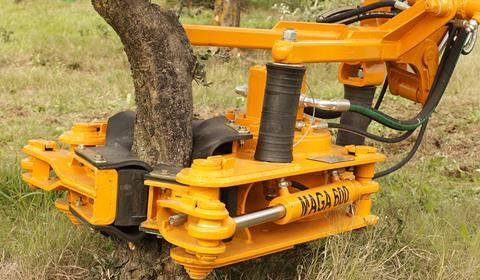
Erreppi’s Maga 800 is a specialised, tractor-mounted mechanical harvesting system designed to shake and dislodge pendant fruits and nuts. The Maga 800 tree shaker, available through Dercomaq, is equipped with two retractable arms, two vibration levels, and a hydraulic system independent of the tractor. It can harvest up to 400 trees per day – equivalent to approximately 1ha in orchards with a 5 x 5m planting grid.
“Its vibrating head is designed to prevent damage to the tree’s bark, roots, and overall structure. Furthermore, by preventing vibrations from being transmitted to the tractor and the operator, it ensures a more comfortable and safer working experience,” Erreppi said.
For the harvesting stage, meanwhile, Erreppi’s Giampi Star 1800 is capable of collecting crops such as hazelnuts, chestnuts, walnuts, and almonds, as well as other products found on the ground. Attached to a tractor and powered via a hydraulic transmission and PTO (power take-off), it operates at speeds between 1 and 5 km/h and requires a minimum of 50 HP.
“Its design makes it a practical solution for producers who need to navigate confined spaces or prefer to carry out harvesting using their own equipment, rather than relying on third-party services,” the company said.
According to Erreppi, the adoption of this type of technology reflects a transformation that extends well beyond a single, particularly successful season. “With an industry that has significantly increased its export volumes, the efficiency of production processes has become increasingly vital for maintaining the competitiveness of Chilean producers,” it said.
“In this context, mechanisation serves as a key tool to support the growth of a sector that already holds a significant share of the country’s agricultural exports and continues to expand its footprint in international markets.”