Banana cultivation generated 41,759 direct jobs and more than 100,000 indirect jobs during 2025
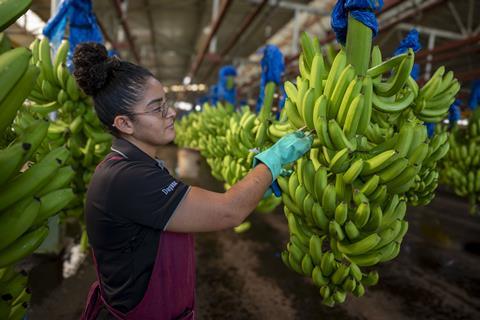
Costa Rica’s banana industry generated 41,759 direct jobs and more than 100,000 indirect jobs in 2025, according to data provided by the Costa Rican Social Security Fund (CCSS). These are concentrated mainly in the Caribbean region and Parrita.
A technical study undertaken by Corbana shows that the banana industry stands out for its formalisation of agricultural employment and for offering wages that, on average, exceed the minimum wage established by the Ministry of Labour and Social Security for occupations related to fruit production by 17 per cent. These wages also surpass the average for other crops.
Moreover, some workers also receive in-kind benefits such as transportation and housing, which increases their total compensation.
In terms of social security, the sector contributed an average of US$5.26mn per month to the Costa Rican Social Security Fund (CCSS) during the last year. All workers in banana companies are properly insured and have workers’ compensation insurance.
“The Costa Rican banana industry is internationally recognised for its strong social and labour policies. Costa Rica offers the highest minimum wage for banana workers in Latin America and guarantees benefits that are still far from being achieved in other countries, such as free education and universal access to social security,” said Corbana’s general manager Marcial Chaverri. “These factors position the country as having one of the highest standards of well-being and protection for workers in the sector.”
Source of employment
Direct jobs generated by the banana industry represent approximately 1.9 per cent of the employed population nationwide, according to data from the National Institute of Statistics and Censuses (Inec).
Together with the more than 100,000 indirect jobs linked to banana cultivation – in areas such as land transport, port operations, agricultural input supply, customs agencies, aerial fumigation, and packaging materials – this percentage rises to 6.5 per cent of the country’s total employed population, reflecting the sector’s impact on the national economy, primarily in rural areas.
In the Huetar Caribe region alone, approximately 83 per cent of the employed population depends on this activity.
Reducing the cost of living: The case of Finca San Pablo
Finca San Pablo, located in the canton of Siquirres, employs 220 people. During 2025, the company allocated nearly CRC50mn in employee benefits to improve working conditions and alleviate the economic burden on families.
The investments included infrastructure improvements in both work areas and common spaces, as well as the provision of school supplies for the children of employees. Employees have access to housing, transportation, food subsidies, educational scholarships, training programs, a solidarity association, direct hiring arrangements, freedom of association, and other benefits. Additionally, job stability and opportunities for advancement have allowed field workers to pursue technical and administrative positions.
Such is the case of Errol Porras, who started harvesting six years ago and currently works as a personnel coordinator. He is also training to obtain his drone pilot’s license.
“In a very short time, I’ve seen many of my colleagues improve themselves. Here, they think about the workers and give us opportunities to grow,” commented Porras, who also lives with his family in one of the homes provided by the company.
As part of its housing programme, the farm has 28 family homes and 38 single rooms, with all basic services and regular maintenance.
Comprehensive well-being: The Fyffes model
Fyffes’ commitment to its employees led to the creation of the Well-being Programme, an initiative that offers free and confidential professional counselling in areas such as psychology, nutrition, finance, and legal matters.
Additionally, employees have access to an annual severance advance for those who meet the requirements, a solidarity association, and the annual distribution of school supply kits for employees’ children.
Pierre Terranova, corporate affairs coordinator at Fyffes, emphasized that the company strives to create an environment that promotes both professional development and the comprehensive well-being and quality of life of its employees.