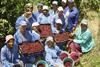
After a successful season and expansion from 185ha to 819ha over the past decade, the cherry industry is positioning itself for export growth

The recent history of South Africa’s cherry industry not only shows how far the sector has come over the past decade but also indicates where its future may lie.
After a great growing season last year and fruit of excellent quality being shipped to local and international markets, the country’s cherry growers have reason to be confident about the future.
Figures previously released by Hortgro indicated that cherry plantings in South Africa surged from just 185ha in 2012 to 819ha by 2024.
“This rapid expansion reflects the broader mindset of South African deciduous fruit producers, who continually seek to optimise production and diversify their market offerings,” the industry body noted.
“Cherries offer an attractive proposition: high potential returns, but also with higher risk.”
Calla du Toit, procurement manager at Tru-Cape Marketing, said cherries fit in well with the infrastructure of deciduous fruit growers.
During the harvesting and packing season, producers have spare capacity and they can focus on cherries as an additional category.
The Western Cape is now the centre of the South African cherry industry, accounting for 61 per cent of all plantings.
Beyond the Western Cape, other regions are emerging as notable contributors. Gauteng and the Northwest together account for 28 per cent of total plantings, highlighting the industry’s growing national reach.
Despite increased production, the domestic market remains the primary destination for South African cherries.
Over the past decade, local consumption has accounted for around 60 per cent of total production.
The highly perishable nature of the fruit, combined with the country’s relatively small share of the global export market, has reinforced the importance of local sales.
Yet cherry growers are also ideally positioned to boost their exports.
“In the traditional markets we can supply in the lucrative Christmas period to the European Union and the UK,” said Du Toit.
“In markets of the east, where we also have very good airfreight options, we are one of the early producers and can supply and clear our fruit before the bulk of the competitive supplies from Chile arrive.”
Hortgro indicated that exports are gaining momentum, with shipment volumes growing to 37 per cent of total production over the past five years.
South Africa’s export window runs from week 40 to 52, peaking between weeks 46 and 48.
To maximise freshness and market value, approximately 70 per cent of exports are shipped by air, particularly to established markets in the UK, the EU and the Middle East.
Looking ahead, access to new markets – most notably China – could be a game-changer for the industry.
“As production continues to rise, international markets will become increasingly vital, as the domestic market alone cannot absorb future volumes,” Hortgro concluded.