Kroger’s Patrick Haines outlines the potential for Chilean cherries in the US at Global Cherry Summit
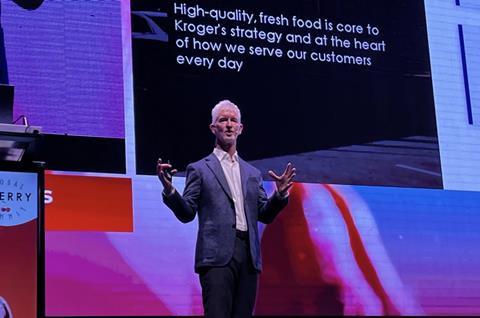
The US market is still far from reaching its full potential for Southern Hemisphere cherries and could grow exponentially with proper management, according to Patrick Haines, vice-president of fresh produce sourcing at leading US retailer Kroger.
Speaking at the 2026 Global Cherry Summit, which took place in San Francisco de Mostazal, Chile last week, Haines argued that cherry exporters should no longer regard the US as a secondary or complementary but rather as a concrete opportunity to build a large-scale winter cherry category by establishing a much more powerful connection with American consumers. “We have the opportunity in the US to sell eight times more cherries than we sell today,” he noted.
Drawing on his decades of experience as a fresh produce buyer – Haines previously worked for Walmart for 34 years – he said his view was based on Kroger’s experience with seasonal transitions in other fruit categories, such as table grapes and easy peelers, where the shift between local and Southern Hemisphere supply maintains much more robust consumption levels than those currently observed for cherries.
Haines said Kroger is looking to get closer to its direct sources of supply and deepen its relationship with fresh fruit suppliers in Chile and Latin America. “We are here, and we will have a greater presence in Chile and Latin America, having one-on-one conversations with you to establish these relationships and make them last a long time,” he noted.
Haines explained that, for table grapes, the Southern Hemisphere accounts for approximately 74 per cent of the volume sold during the Northern Hemisphere summer. In citrus, that proportion reaches nearly 76 per cent. But in cherries, the story is very different: the volume from the Southern Hemisphere is equivalent to only 9 per cent of the Northern Hemisphere’s business.
From that perspective, he said the problem isn’t the absence of a market, but rather the need to increase its development. Haines noted that it’s not enough for the fruit to simply reach its destination; the key is how it establishes itself as a category, how it’s communicated, and how it integrates into the American consumer’s shopping routine during a window in which cherries still don’t have the shelf space that other imported fruits have achieved.
Haines predicted that, if all stakeholders align, the opportunity for Chilean cherries in the US could amount to an US$800mn business.
But, he said, this would require planning, commercial commitment, and an explicit willingness to build a market, something he characterised as a shared challenge. “In this room are all the people who can generate that impact. Let’s draw up a plan,” told the audience.