The project brings together AgriSound, PheroSyn, and Oakford Farm to tackle pollination challenges in UK strawberry production
UK bioacoustic crop monitoring specialist AgriSound has been awarded funding as part of the Innovate UK Full Adopt Grant Round 3, to support its project aimed at improving strawberry pollination through advanced monitoring and novel bee attractant technology.
The project, titled ’Trialling a novel bee attractant to improve strawberry pollination’, brings together a consortium including AgriSound, PheroSyn, and commercial grower Oakford Farm.
The initiative will run for 12 months, having started in March 2026.
Pollination remains a critical challenge for UK strawberry growers, particularly in protected environments where up to 90 per cent of crops are produced.
Despite the widespread use of bumblebees, inconsistent pollination can lead to significant crop losses, with up to 9 per cent of fruit wasted due to poor shape or size.
According to AgriSound, the project aims to address that gap by combining cutting-edge bioacoustic monitoring with innovative pollinator attractants.
AgriSound’s technology will track bee activity in real time using advanced algorithms, enabling growers to better understand and manage pollinator distribution across their crops.
By integrating these insights with PheroSyn’s novel attractant compounds, the project seeks to actively guide bumblebee movement within polytunnels – targeting areas where pollination is currently insufficient.
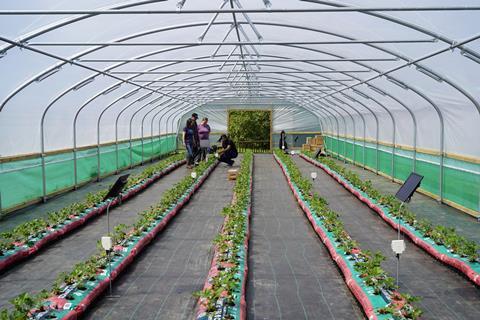
Field trials will take place across four commercial strawberry polytunnels, where bee activity, fruit yield, and quality will be closely monitored.
The goal is to demonstrate a scalable, data-driven solution that improves both productivity and sustainability for growers.
“Pollination is one of the most important – and least optimised – factors in protected crop production,” said Robin Wilson, pollination specialist at AgriSound.
”This project represents a major step forward in giving growers the tools they need to actively manage pollination, rather than simply relying on it.”
Dr Mary Ellis, CEO of PheroSyn, noted that the group’s work on semiochemicals has shown strong potential to influence insect behaviour in agricultural settings.
”This collaboration allows us to apply that science in a highly practical way, helping direct pollinators to where they are needed most and improving crop outcomes.”
Ben Earle, partner at Oakford Farm commented: “Achieving consistent pollination across large polytunnel sites is a real challenge for us.
”Being part of this project gives us the opportunity to trial new tools that could make a meaningful difference to both yield and fruit quality.”
The project aligns with broader industry goals to reduce waste, increase efficiency, and enhance sustainability in UK horticulture, the groups stated.
By improving pollination outcomes the consortium aims to deliver tangible benefits across the supply chain, from growers to retailers and consumers, they added.