New system Qualicrop combines multispectral imaging and robotic sorting to remove defective tomatoes at commercial packhouse speeds
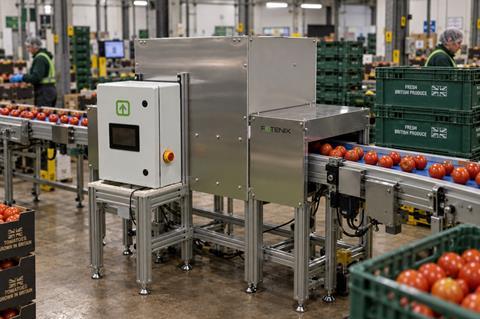
UK agri-tech companies Fotenix and Leap AI have developed an automated grading line designed to detect defective tomatoes and remove them off a moving conveyor belt.
Called QualiCrop, the system combines multispectral imaging with robotic handling to automatically separate healthy fruit from defective fruit with 87 per cent accuracy.
The system was funded by Innovate UK and led by Fotenix in collaboration with Leap AI and the University of Lincoln.
While most automated packhouse sorters rely on RGB cameras to assess characteristics already visible on the fruit’s surface, QualiCrop uses Fotenix’s Automated Quality Control (AQC) system to identify defects not yet visible to the human eye.
The imaging system analyses reflected light across targeted wavelengths to identify changes associated with damage, disease and mould before visible symptoms develop.
Charles Veys, CEO of Fotenix, said: “The AQC classified each tomato in real-time so the robotic sorting cell could act on that data while the fruit was still moving. That quality data was also collated by batch and growing site, delivering insight growers can use to help to inform growing strategies upstream.”
Fotenix led the project and supplied the AQC system, while Leap AI has built specialist hardware and software for end-of-life packing solutions for fresh produce.
The University of Lincoln, which is widely recognised as a leading agri-tech and agri-food technology innovator in the UK, developed detector algorithms that reduced the data required to identify a defect from 400 wavelengths to 18.
The university also hosted the commercial trials, which used tomatoes from UK grower APS salads.
The new system also aims to make advanced automated grading more affordable for small and medium-sized UK greenhouse businesses operating across three to 25 hectares, since existing sorting systems can cost upwards of £1mn.
Ben Stuart, CEO of Leap AI, commented: “As specialists in the robotic handling of fresh produce, we are always looking to bring additional value to our customers. We are excited to pair our top-of-the-line automation, including defect removal with our existing end-of-line packing solutions.”
The University of Lincoln is also taking the imaging research into two further Innovate UK projects focused on tomato harvesting and glasshouse growing systems.