War will drive up costs even further for growers who already face heavy administrative burden and labour shortage, says industry body
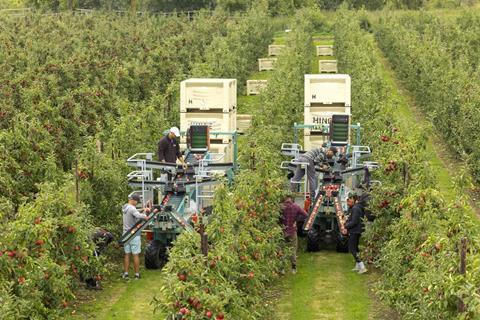
War in the Middle East is expected to drive up costs even further for British apple and pear growers, at a time when the financial burden of certification and labour are already extremely heavy.
That’s according to a new survey published by British Apples & Pears Limited (BAPL), which suggests audit and compliance demands and labour costs are the dominant pressures on UK apple and pear businesses.
Farm assurance, compliance and audit represent the highest-scoring issue, with 97 per cent of growers and 67 per cent of grower/packers identifying this among their three most important business challenges.
The cost of labour, meanwhile, is cited by 85 per cent of growers and 89 per cent of grower/packers among their top three concerns.
“Farming is less fun than it was: paperwork, low returns, labour problems and cost – and now I can’t pass assets to my son, so why bother?” said one unnamed grower.
Signs of improvement
While growers continue to flag severe pressure on costs and long-term returns, the survey does indicate some improvement compared with 2023 in two key areas.
Firstly, only 43 per cent of respondents said they were less confident about the future than a year ago, compared with 70 per cent who previously said they were.
And secondly, 14 per cent of those surveyed described their relationship with supermarkets as a “true partnership”, up from just 3 per cent in 2023.
As a result, BAPL sees the direction of travel as positive but warns that progress will not hold unless the industry tackles the compounding impact of compliance burden, labour challenges, and volatile input costs.
Immediate pressure
Much has changed even since the survey was conducted. BAPL warns that the US-Israel-Iran conflict is now driving a rapid escalation in key inputs, and comes at one of the worst possible moments for top fruit growers.
“February and March are the very start of the growing season, and the period when many orchards must secure fertiliser and fuel for spring operations – purchases that cannot simply be deferred,” it noted.
One British apple farm is said to have reported that fertiliser costs were already 42 per cent higher than the same time last year.
The same business is said to have reported kerosene and heating oil moving from around 65p/litre to £1.30/litre in recent weeks.
BAPL says growers are also reporting sharp volatility in red diesel pricing and availability.
Cut off
Disruption around the Strait of Hormuz is a key driver of the current volatility. “The Strait is a major global shipping chokepoint for energy and fertiliser supply chains,” a spokesperson for BAPL said.
“Disruption in and around Hormuz can restrict shipments and raise freight and input costs, while higher gas prices can quickly translate into higher nitrogen fertiliser prices – natural gas typically accounts for around 60-80 per cent of nitrogen fertiliser production costs.”
An anonymous grower/packer said: “We can’t pause the season. These are inputs we need now – and sudden price spikes feed straight into our cost of production.”
Ali Capper, executive chair of British Apples & Pears, said: “This survey shows the scale of pressure growers are under from audit burden and labour costs – and now we are facing a fresh input-cost shock just as the season starts.
“Growers’ confidence has improved since 2023, but it won’t hold if another prolonged input-cost shock takes hold. Growers can’t simply pause buying fertiliser, fuel and energy. If these cost spikes persist through the spring, they will feed directly into food inflation.”
Capper said it was vital that government and the supply chain act early. “Ministers and the Bank of England need to understand what’s happening on the ground, and the Grocery Code Adjudicator should remind retailers of the rules around cost-inflation discussions so legitimate increases can be addressed fairly.”