Tree management platform to aid harvest and orchard management

The trial of a new multi-function tree management platform has commenced in Western Australia, supporting the adoption of technology at the state’s Narrow Orchard Systems research site.
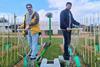
The Department of Primary Industries and Regional Development (DPIRD) purchased the electric-powered Frucotec Berglady platform, which enables two people to safely harvest and work on trees at height, instead of using ladders.
The new acquisition adds to the suite of equipment and smart technologies being tested at DPIRD’s Narrow Orchard Systems research and demonstration site at its Manjimup Horticulture Research Institute.
The DPIRD trial will inform the five year national Narrow Orchard Systems for Future Climates Hort Innovation project, along with other states, universities and industry, including Pomewest.
DPIRD fruit and perennial crops lead, Dario Stefanelli said the department would examine how the platform could help improve orchard efficiencies, safety and sustainability.
“The platform’s narrow design makes it suitable for use in 2D multileader narrow rows from 2m, while it can service trees of up to 3.5m in height – allowing two people to work simultaneously across rows at varying heights,” Stefanelli said.
“While there are obvious labour benefits for harvesting, it can also be used for pruning, tree training, binding, thinning, opening hail nets and other year-round maintenance tasks. The electric powered machine has zero emissions and its lightweight build means reduced soil compaction.
“The trial will assist growers to think about how new technologies, like the platform, can fit into their operations and give them confidence when investing in Narrow Orchard Systems.”
The Berglady platform is still relatively new in Europe and this is the first time it is being evaluated in Australia. Stefanelli said the use of the platform would also improve safety and efficiency, when pruning at height.
“Making it easier and quicker to prune at height is one of the keys to facilitating the transition to narrow row multileader orchards with 2D uniform canopies,” he said.
“This style of pruning allows for better light distribution through the canopy, encouraging early fruit-bearing, less variation and fruit set, while improving fruit uniformity, colour and size.
“It’s all part of the Narrow Orchard Systems project and developing a full package – superior cultivars, orchard design and technology – to make next generation orchards more productive, smarter and safer.”
The new platform is being tested on DPIRD’s 0.4ha Narrow Orchard Systems demonstration site of about 650 ANABP apples, including the popular variety that produces Bravo apples, grafted onto three different dwarfing and semi-dwarfing rootstocks.
The project has been exploring the use of an autonomous sprayer, light detection and ranging (LiDAR) technology or cameras, plant and soil moisture sensors and developing an open-source dashboard for easy data collection.
Hort Innovation general manager production and sustainability R&D, Anthony Kachenko said the new technology would provide important evidence to support growers’ decision making.
“With DPIRD’s purchase and trial of the electric Frucotec Berglady platform, we’re accelerating the practical uptake of technology‑enabled Narrow Orchard Systems in Australia,” he said.
“The learnings from Manjimup will feed directly into Hort Innovation’s national Narrow Orchard Systems for Future Climates project to give growers evidence‑based confidence to invest in safer, more efficient and climate‑resilient orchards.”