Food security will not be solved by farming alone. It will be solved by infrastructure funded at scale
The next structural crisis may not be energy, finance or migration. It may be food. Not because we lack land, technology or agronomic knowledge, but because we lack inclusion. The food system was built on the assumption that volume would always be there.
But volume does not appear out of thin air – it comes from millions of small and medium growers. They are not the exception; they are the majority. For decades, the industry operated under a simple mental model: emerging countries produce, developed countries import, and markets clear. That model is now outdated.
Agriculture is ageing everywhere. Fewer young people are entering the sector, and the workforce that remains is under-equipped for rising standards in compliance, traceability, labour, quality and sustainability. At the same time, conscious demand has outpaced conscious supply. Consumers and retailers are asking for cleaner, traceable and certified food faster than producers can adapt.
This gap is not ideological – it is structural. Small and mid-size growers lack the technical assistance, certifications, data, logistics, working capital and technology required to reach these markets. In many regions, the absence of basic digital onboarding and farm-level data makes compliance and traceability nearly impossible. The result is a widening mismatch between what the market demands and what the system can supply.
In a recent conversation, the former CEO of one of the world’s largest fruit companies noted that countries have reduced strategic food reserves at the same time supply chains have become longer, leaner and more optimised. Strategic de-stocking may lower costs, but it weakens resilience. Efficiency works in stable environments; it falters in volatile ones.
Food crises do not erupt overnight. They accumulate slowly through fragmentation, under-investment and logistics failures, and then break abruptly. If we don’t intervene now, it will not be this generation that faces the consequences, but the next two. The only way to avoid a food security crisis is to industrialise inclusion. If small and medium growers do not enter compliant supply chains, there will not be enough volume or resilience to feed the system – regardless of geography. And here’s the part we rarely discuss: nothing happens without capital and political will.
Unlocking global food resilience will require billions – not in planting more farms, but in building the invisible midstream infrastructure that makes agriculture investable: standards, traceability, logistics, technical assistance, digital systems, working capital, export protocols and farm-level data infrastructure.
For inclusion to work, producers who do it well must be rewarded for doing it well. That requires measuring performance, differentiating between growers, and pricing accordingly. Data enables incentives; incentives enable adoption; and adoption enables volume. There is no resilience without market mechanisms that reward performance.
At Equilibria, we’ve been prototyping in this direction. Our work integrates production from our own farms with technical assistance, traceability, certifications and direct export into a single system that enables large and small growers to coexist under compatible standards and participate in higher-value markets. A key component has been technology – specifically EQApp, a farm-management platform built not as a high-end enterprise system but as adoptable, simple and scalable software for rural conditions, enabling data capture, compliance, farmer onboarding and export readiness where connectivity, capital and technical capacity are limited.
Early signals of this transition are already visible. Yet the scale of the challenge requires a different order of magnitude: what is currently being deployed is measured in millions; what the system needs will be measured in billions. Food security is not a subsidy problem – it is an infrastructure problem.
Food will not be secured by farming alone. It will be secured by midstream infrastructure, incentives and coordination funded at scale. And within that transition lies one of the largest underpriced opportunities of our time: enabling millions of small and medium growers to operate as compliant, data-driven, market-aligned suppliers.
The unanswered question is not whether this transition will happen, but when, who will lead it, and which funds, development banks and financial institutions will recognise the opportunity first – and position themselves as the first movers in a market that is about to be repriced.
Food is not just food. Food is infrastructure.
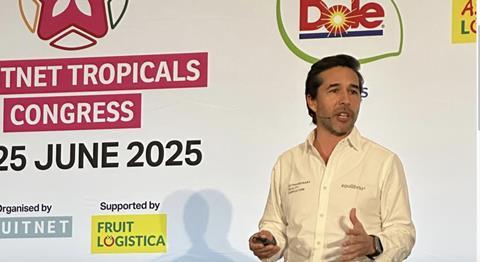
Juan Pablo Duque is CEO of Equilibria, a Colombian lime export company that was selected as the best global agtech startup at leading US investment fair SelectUSA in 2025.