Fresh trade opportunities on offer for exporters of both markets as negotiations on new FTA conclude
Australia and the European Union have signed a free trade agreement set to lower trade barriers between the two markets, including those for fresh fruit, vegetables and nuts.
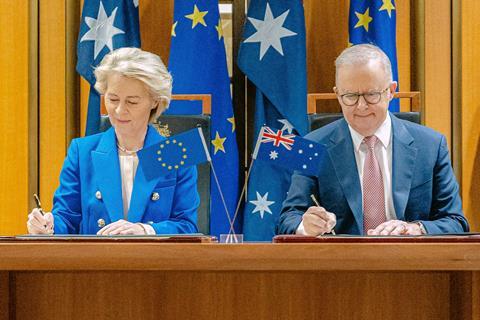
The Prime Minister of Australia, Albanese MP, and President of the European Commission, Ursula von der Leyen welcomed the conclusion of negotiations on the Australia–EU FTA in Canberra on 24 March 2026. The agreement must pass through the respective domestic processes required for signature before entry into force.
“This agreement will strengthen bilateral trade and investment, support economic growth, and reinforce the shared commitment of Australia and the European Union to open and rules-based trade,” the two leaders said in a joint statement.
Fresh produce exporters from both markets will benefit from tariff elimination. The EU had a positive trade balance with Australia for agri-food products worth €2.3bn in 2026. European farmers and food businesses will gain even easier access to the Australian market with tariffs dropping to zero on all products.
The agreement takes account of the interests of EU producers of sensitive agricultural products. Access to the EU market will be limited through calibrated tariff rate quotas, including an 800-tonne quota for sweetcorn.
Once fully implemented, 94.8 per cent of the value of Australia’s agricultural exports will enter the EU duty-free. Australia’s current horticulture exports to Europe are relatively low accounting for only 7 per cent of total value. In the 12 months to June 2025, 40,359 tonnes worth A$192.3mn were shipped to Europe with almonds and onions representing the top categories.
EU tariffs on tree nuts will be eliminated immediately on implementation, including tariffs of up to 5.6 per cent on almonds, 5.1 per cent on walnuts and 2 per cent on macadamia nuts.
The ‘ad valorem’ component of tariffs in the EU’s Entry Price System on fruit will be eliminated once the agreement is fully implemented. While the EU’s Entry Price System will be maintained, the relatively high value of Australian produce means this will effectively result in duty-free treatment.
This will see EU seasonal tariffs on apples of up to 9 per cent eliminated over seven years and tariffs on pears of up to 10.4 per cent eliminated over three years.
Australian vegetable export boost
Tariffs on most Australian vegetable exports to the EU will be eliminated on implementation, including tariffs of up to 9.6 per cent on onions, 13.6 per cent on carrots and a 11.5 per cent on potatoes.
Tariffs on beans, fresh olives, fresh sweetcorn, dried sweetcorn, frozen mushrooms, preserved mushrooms, cassava, sweet potatoes, yautia and arrowroot will also be eliminated over three years.
The agreement will also eliminate the ad valorem component of the tariffs in the EU’s Entry Price System on vegetables (excluding sweetcorn).
While the EU’s Entry Price System will be maintained, this will effectively amount to duty-free treatment. This will see tariffs of up to 14.4 per cent on tomatoes, 12.8 per cent on cucumbers, 12.8 per cent on courgettes and 10.4 per cent on globe artichokes eliminated.
Peak industry body for the Australian vegetable industry, Ausveg, welcomed the FTA and said it would provide a much-needed boost to Australia’s onion industry, while also leading to opportunities for exporters of other vegetable crops.
The European Union has traditionally been a strong export market for Australian onions in particular, with about 10,000 tonnes, worth A$11mn exported to Europe in both 2023 and 2024. However, since an EU FTA with New Zealand came into force in mid-2024 – eliminating tariffs on New Zealand onions into Europe – Australian onion exports to this large Northern Hemisphere market declined by almost half in 2025, to 5,300 tonnes worth A$5.8mn.
Over the same period New Zealand onion exports to the EU climbed from 42,800 tonnes in 2024 to 46,500 tonnes in 2025, reflecting the nation’s enhanced competitiveness as a result of the NZ-EU FTA.
In welcoming the reaching of a deal, Ausveg CEO Michael Coote said once in force the Australia-EU FTA should, at a minimum, allow Australian onion exports to Europe to begin recovering to levels seen prior to 2024.
“Australia achieving an FTA with the European Union is welcome news which will benefit Australian grower-exporters of onions, and other vegetable crops through tariff elimination and reductions,” said Coote.
“The Australia-EU FTA will not only provide opportunities for onion grower exporters to recover recently-lost market share, but also gain new ground through more competitive international trading terms.
“This is good news in light of the severe upheaval and surging production costs due to the Middle East conflict that is continuing to present Australian vegetable growers with major new challenges. While the major difficulties for vegetable producers flowing from the conflict must remain an urgent priority for government to address, news of improved market opportunities into the significant European market is welcome.”