Industry leaders explore benefits of collaboration, greater transparency, and stronger security practices at Fruit Attraction event
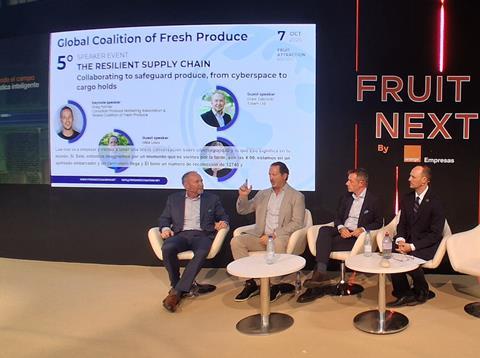
Navigating challenges such as protecting product quality, minimising losses, and maintaining business relationships across increasingly complex global supply chains took centre stage at a speaker event organised by the Global Coalition of Fresh Produce at last week’s Fruit Attraction.
Titled ‘The Resilient Supply Chain: Collaborating to Safeguard Produce, from Cyberspace to Cargo Holds’, the event invited industry leaders to explore how collaboration, greater transparency, and stronger security practices can help businesses protect products and build more resilient supply chains – from farm to market.
The programme featured keynote speaker Greg Palmer of the Canadian Produce Marketing Association and the Global Coalition of Fresh Produce, alongside Mike Laws of Laws Logistics and the International Fresh Produce Association, Drew Zabrocki of Totem, Steve Alaerts of Foodcareplus, and Ellen Pay of the Global Coalition of Fresh Produce.
Diversified sourcing and flexible logistics
In his keynote address, Greg Palmer highlighted how changing growing conditions and market requirements are driving the need for more flexible sourcing and stronger connections between buyers and alternative production regions. Diversifying origins can create new opportunities, but also increases the importance of reliable logistics, timely information, and coordination between operators.
According to Palmer, rising demand and the need to protect highly perishable products are increasing pressure for faster, more frequent shipments, supported by efficient shipping routes, seasonal planning, and investment in port and road infrastructure.
“These trends underline the need for a more responsive supply chain – one that can adapt to changing production conditions, shipping disruptions, and market demands while protecting product quality and reducing waste,” he said.
Three doors, one shared vulnerability
Logistics flexibility alone cannot guarantee resilience. In his presentation, Three Doors In: Security, Fraud, and the Trust Layer Fresh Produce Has to Build Together, Drew Zabrocki explored another growing challenge: the vulnerability of supply chains to cyberattacks, cargo theft, and fraudulent information.
Using real-life cases, he illustrated three potential points of failure: vulnerabilities in shared software, criminals impersonating legitimate transport operators, and falsified documents, such as false origin paperwork or fraudulent payment requests. A familiar email address, a convincing origin certificate, or a seemingly legitimate invoice may not tell the whole story.
According to Zabrocki, businesses often lack an independent way to verify the claims made by their partners. “Because these relationships extend across the entire industry, no single company can solve the problem alone,” he said.
Zabrocki highlighted practical safeguards, including understanding dependencies on third-party software, maintaining tested backups, verifying carriers through independently sourced contact details, and confirming payment changes through separate communication channels.
Zabrocki therefore called for a shared, independently verifiable foundation of trust, supported by common standards and open, community-owned tools. He highlighted a proposed pre-competitive working group under COSSAF, the Collaboratory for Open Software & Services in Ag and Food, as a potential avenue for industry collaboration.
Laws and Alaerts echoed Zabrocki’s concerns, agreeing that cybersecurity is an increasingly critical issue for the fresh produce industry. They stressed the need for secure, robust systems connecting operators across the supply chain to protect data, prevent fraud and, ultimately, preserve the trust on which reliable business relationships depend.
A shared charter for resilient supply chains
How can the fresh produce industry reduce delays, prevent waste, and make global supply chains more resilient? For Ellen Pay of the Global Coalition of Fresh Produce, disruption is a reality of global trade, but its impact can be reduced through better preparation and collaboration. As she explained: “We cannot prevent every disruption, but we can prepare for it better. Through proactive planning, greater coordination, and stronger responses when challenges arise, we can build supply chains that are more stable and more resilient”.
With this goal in mind, Pay presented the Coalition’s Charter of Good Shipping Practices, a voluntary initiative that translates these principles into a shared framework for more transparent, efficient and fair logistics. The Charter is built around five guiding principles: collaboration and communication; fair and transparent business terms; competition and efficiency; cargo integrity and product quality; and resilience and risk preparedness.
Together, they address some of the practical challenges facing fresh produce businesses: the need for timely information, clearer commercial terms, fairer sharing of costs and risks, and logistics practices that protect the quality and value of perishable goods. Better coordination can help businesses respond to disruption, avoid unnecessary inefficiencies, and reduce food waste.
Pay stressed that the Charter is not about imposing new rules, but about establishing a common reference point for the industry.
“This is not about one player versus another,” she said. “It is about the supply chain we all share. If we can build greater transparency, fairness, and efficiency into our relationships, we can create a system that is stronger and more sustainable for everyone.”
Pay closed by calling on businesses and industry associations to contribute to the Charter’s development and help turn it into a practical tool for the entire supply chain.
Building resilience together
The discussions at Fruit Attraction highlighted how closely the industry’s challenges are connected. Climate disruptions are changing where produce can be sourced; evolving markets are demanding faster and more flexible transport; and growing digital and commercial risks are making trust and verification indispensable.
No company can build a resilient supply chain alone. Progress depends on cooperation between growers, exporters, logistics providers, buyers, and industry organisations, supported by shared standards, reliable information, and practical safeguards. The Charter of Good Shipping Practices, presented by the Global Coalition of Fresh Produce, provides a voluntary framework to turn this shared commitment into action through better communication, fairer business practices, and stronger risk preparedness.