European fresh produce sector demands data-driven implementing regulations and single market guarantees
Regulatory clarity, consistent implementation rules and timelines, and the protection of the single market: these are the primary demands of the European fresh produce sector ahead of the Packaging and Packaging Waste Regulation (PPWR) coming into general application.
According to industry representatives, the lack of clear definitions, predictable and reasonable implementation timelines, and a harmonised EU-wide approach risks resulting in increased costs throughout the entire supply chain. This could impact business competitiveness, the availability of fresh fruit and vegetables, and ultimately, consumption of healthy products and the proper functioning of the European single market.
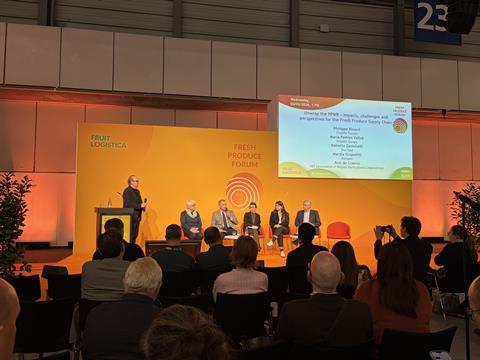
These points emerged from the Fresh Produce Forum session “Unwrap the PPWR – impacts, challenges and perspectives for the Fresh Produce Supply Chain”, jointly promoted by Freshfel Europe and Pro Food, which was held at Fruit Logistica earlier this month.
The meeting brought together representatives from the packaging industry and the fresh produce sector to analyse the regulation’s implementation framework, the role of delegated acts and future guidelines, as well as the key operational and economic challenges the industry will face in the coming years.
The proceedings were opened by Philippe Binard, general delegate of Freshfel Europe, who provided a comprehensive overview of the PPWR, drawing attention to implementation timelines and the specific implications for the fresh fruit and vegetable sector– a sector that accounts for a marginal share of European food packaging, has been highly impacted by the PPWR and discriminated against compared to other sectors with higher share of packaging. Packaging plays an essential role in ensuring product quality, food safety, and waste reduction throughout the value chain.
Maria Pamies Vallvé, sustainability policy advisor at Freshfel Europe, followed by focusing on the implementation aspects of the new rules, outlining the progress made on delegated acts and future implementation guidelines. During her presentation, she also highlighted the critical issues identified in the recent EFSA survey carried out by the European Commission, stressing the need for a consistent, data-driven approach and greater alignment with the unique operational characteristics of the fresh produce supply chain.
Roberto Zanichelli, member of the Communication Committee of Pro Food — the product group within the Italian Rubber and Plastics Federation (Federazione Gomma Plastica) representing fresh food packaging manufacturers — also took part in the debate. Zanichelli emphasised that the sector is not opposed to regulation but demands that the implementation of the PPWR be guided by a pragmatic, evidence-based approach, specifically utilising Life Cycle Assessment (LCA) analyses. This is to avoid ideological choices that could increase food waste and compromise the overall sustainability of the supply chain.
Zanichelli drew particular attention to the significant economic implications of implementing the regulation, highlighting how the absence of clear and stable definitions in the delegated acts could lead to high conversion costs, misdirected investment, and increased uncertainty for businesses, with potentially negative consequences for the overall sustainability of the sector. He further drew attention to the critical issues related to Annex V and to differentiated national exemption lists, which risk undermining the principle of the EU single market and leading to regulatory fragmentation.
Marzia Scopelliti, senior public affairs manager at Europen — the European organisation representing the entire packaging industry value chain — also addressed the forum. In her contribution, Scopelliti pointed out that the phase of defining delegated acts and implementation guidelines is crucial for ensuring regulatory clarity, consistency and predictability. These conditions are essential for allowing supply chain businesses to plan investment and operational compliance within a framework of robust legal certainty.
A central theme of the discussion was the risk of fragmentation within the European single market. On this point, Ann De Craene, representing VBT, flagged the concerns of fresh produce growers regarding the possibility of member states adopting divergent national exemption lists for fruit and vegetable products. Such a scenario would risk creating competitive distortions and obstacles to the free movement of goods, thereby compromising the proper functioning of the European single market.
At the conclusion of the meeting, a shared position emerged from across the sector: without a harmonised EU-wide approach and an objective assessment of the environmental, economic and social impacts of various packaging solutions, the implementation of the PPWR could result in increased costs throughout the entire chain. This would affect business competitiveness, the availability of fresh fruit and vegetables, and ultimately consumption levels, which are already declining in many European countries, without delivering tangible environmental benefits.
Ahead of the PPWR coming into general application — scheduled for the second half of 2026 — the European fresh produce industry is calling for implementing regulations that are data-driven and capable of safeguarding the single market. This objective can be achieved through the full involvement of stakeholders and by directing measures towards environmental sustainability, food safety, and the comprehensive protection of the European single market.