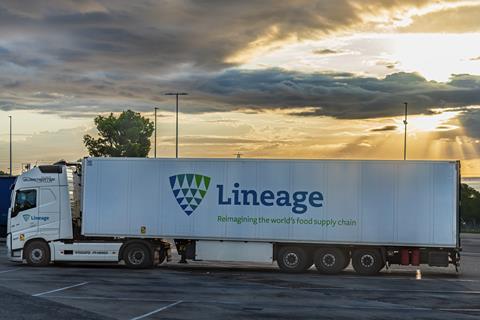
Temperature-controlled logistics specialist Lineage has released a new report detailing the results of its Cold Chain Insights Survey.
The survey asked 1,000 North American food and beverage supply chain decision-makers about the pressures and opportunities facing their companies and their cold chain partners in 2026.
According to Lineage, the findings point to a broader industry shift, with supply chain leaders indicating they want their cold chain network providers to deliver not only storage and transportation, but also the flexibility, visibility and resilience to navigate a more dynamic operating environment.
Companies have been navigating a period of sustained complexity shaped by policy shifts, cost pressures, innovation and changing consumer demand, the survey revealed.
They have responded with a growing focus on building cold supply chains designed to adapt, scale and respond in real time.
”Food and beverage company leaders are no longer reacting to isolated disruptions; they are operating in an environment where volatility has become a persistent condition to plan against,” Lineage outlined.
”Companies are strengthening resilience strategies, increasing investments in data and automation and seeking closer alignment with logistics partners.
”In practice, this is meant to enable greater flexibility in network design, better visibility across operations and closer partner coordination in real time,” the group added.
External uncertainty and instability are driving planning conversations among supply chain leaders.
Lineage’s survey data found that 56 per cent of leaders rank tariffs, regulation and political shifts as the top three decision drivers.
Companies are adapting by embedding policy risk into their planning strategies, as 73 per cent expect tariffs to continue negatively affecting financial performance in 2026, while 57 per cent say the impact of tariffs on costs in 2025 were higher than expected.
”The findings suggest that food and beverage companies are no longer treating disruption as a temporary factor and are adjusting their strategic frameworks to accommodate it,” Lineage said.
The responses also reveal how customer priorities are evolving across demand planning, technology, trade strategy and partner expectations.
Demand for refrigerated and frozen foods is growing and getting more complex, the group said, with supply chain leaders increasingly looking for cold chain networks that can help them make faster, more informed decisions as conditions evolve.
Tariff pressures are driving domestic trade realignment, with companies placing a greater emphasis on building supply chains designed to navigate market and policy complexity.
In addition, AI and data are becoming performance drivers, as data visibility and technology integration become critical differentiators for cold chain providers supporting complex supply chain operations.
”The findings in Lineage’s survey report indicate that 2026 could cement a structural shift,” the company summarised.
“As companies seek to identify ways to adapt to market volatility while still meeting rising demand, resilience is being redefined.
”The industry is placing greater importance on the ability to integrate data, scale operations and adapt in real-time to external instability,” Lineage noted.
”For supply chain leaders, this means choosing cold chain partners that can provide not only infrastructure, but also the technology, insights and operational agility needed to support long-term performance.
“Success will depend less on reacting to change and more on building systems designed to absorb it,” it concluded.