New A-Eye model uses deep learning to identify stems, weeds and plant material in green beans and spinach, boosting stem-end detection rates
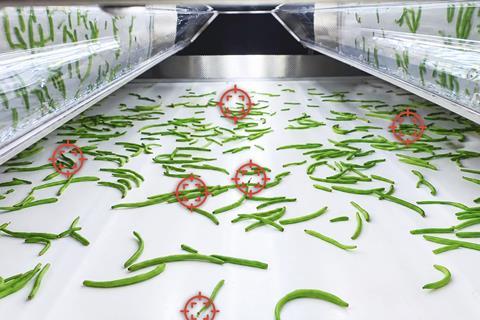
Belgium-based Optimum Sorting has launched A-Eye, a new sorting model for green beans, spinach and other vegetables.
According to the group, the AI-powered sorting model is designed to distinguish defects and plant material from good product without sacrificing yield.
”By leveraging deep learning, the system can detect and remove defects in green beans and spinach that have long challenged conventional sorting technology,” it stated.
This includes stems, weeds and other plant material that closely resemble good product.
The launch of A-Eye is the result of ”years of research and practical expertise in sorting technology”, Optimum noted, with the company investigating how deep learning can be used since 2019.
“We have been working with deep learning in various sorting applications for years, including the detection of cracks in whole carrots,” said Steve Raskin, CSO at Optimum Sorting.
“Today, the technology, computing power and training methodologies have advanced to a level where these models can be deployed reliably in industrial production environments.
”As a result, we can now address sorting challenges that were simply not feasible a few years ago.”
Jan De Jonghe, CTO at Optimum Sorting, explained that while the model is powered by AI, it is designed to assess objects in the same way as a human eye.
Unlike traditional sorting algorithms, which rely on predefined rules, A-Eye learns from real-world examples.
As a result, the model can identify subtle differences that are difficult for conventional vision systems to detect.
“One of the most common misconceptions about AI is that it automatically knows what good product looks like and what doesn’t,” Raskin continued.
“In reality, every model is built on the expertise of product specialists. Their knowledge shapes the training data and teaches the system what to look for when identifying defects.
“You could say we’re translating human expertise into a model that can apply the same judgement more consistently and thousands of times per second,” he pointed out.
Optimum Sorting said it chose green beans and spinach as the first applications for A-Eye, product streams that are particularly challenging to sort as defects often closely resemble the product itself.
Purslane (Portulaca oleracea) is one of the clearest examples of the value A-Eye can deliver, De Jonghe outlined.
“Purslane detection is one of the best examples of what deep learning can achieve,” he said.
“After harvesting, this plant shares so many visual characteristics with green beans that reliably distinguishing between the two becomes extremely difficult using conventional technology.
“As a result, growers have seen entire batches rejected, even though a significant portion of the crop still met quality specifications,” he commented.
“With A-Eye, we can identify purslane far more accurately, allowing more valuable product to be retained. The result is less food waste and significant savings throughout the season.”
According to the company, detection rates for stem ends in green beans increased from 70 per cent to 97 per cent using A-Eye, resulting in a cleaner end product and higher overall product quality.
A-EYE also enables higher sorting line capacities, it added, with the system continuing to classify products accurately even when vegetables partially overlap on the conveyor – allowing processors to increase throughput without compromising sorting performance.