Efforts to arrest declining vegetable consumption have largely been futile, but the versatile aubergine offers a way to attract a younger audience
Considering the gulf in marketing budgets between producers of healthy versus unhealthy foods, and the absence of a truly effective government-led messaging campaign, it is perhaps little wonder that vegetable consumption has been going in only one direction.
According to the Food Foundation, low fruit and vegetable intake has long been a challenge in the UK and the latest National Diet and Nutrition Survey data suggests the situation is indeed worsening.
“Only nine per cent of 11-18 year-olds meet the five-a-day target – the lowest of any age group,” the charity said. “No age group meets the recommendation, though older adults (65+) in the highest income decile come closest.”
One glimmer of hope has come from the rise in plant-based, vegan and flexitarian diets, which have made a product like the aubergine increasingly popular for its uniquely meaty texture and the rise of Mediterranean, Middle Eastern and South Asian cuisines.
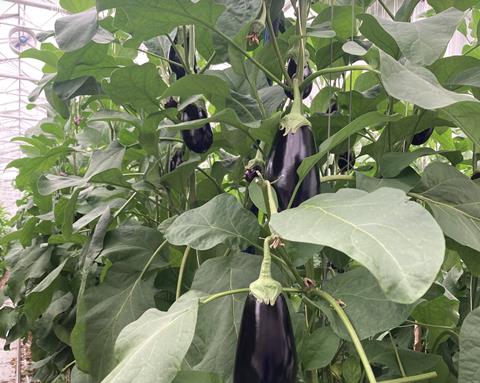
Belgian aubergine producer Stannuco, a member of the BelOrta cooperative, operates a state-of-the-art, fully automated glasshouse, all 6ha of it just for aubergines. The first of the new season, sold in mid-February, came from this very glasshouse.
Co-owner Steven Van Nuffelen says most of Stannuco’s aubergines are exported to Germany, with smaller volumes being sent to the UK and Scandinavia. “Interest from the UK is growing, however,” he reveals. “Young people, especially, are more open to trying aubergines. They see it in recipes online. And restaurants often have an aubergine dish as their vegetarian option, so there is potential for growth.”
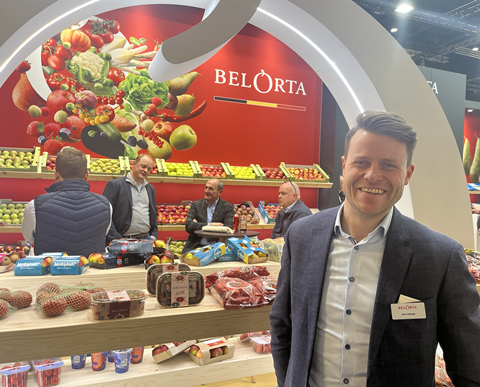
Consumption is also on the rise in Belgium, driven by growing uptake among younger consumers, according to BelOrta’s marketing manager, Glenn Sebregts. The acreage is also on the rise, he adds, so greater volumes are anticipated, dependent on uncontrollable factors like availability of sunlight. BelOrta is set to launch a brand-new box for its aubergines, he reveals, featuring the logos of both BelOrta and Flandria, the quality label for Belgian produce.
Statistics from VLAM, Flanders’ Agricultural Marketing Board, show that Belgium exported fewer aubergines to the UK in July to October 2025, compared with the same period the previous year, but a higher volume during the March to June period.
“The total amount exported to the UK in January to November 2024 was nearly the same as in January to November 2025,” says Anna Duginova, export advisor at VLAM. “Due to a warmer and earlier summer and better weather, we had more production.”
The health benefits of aubergines are seen by some as key to its success and future growth, including an antioxidant associated with lowering ‘bad’ cholesterol. Aubergines are also regarded as a great source of fibre and nutrients that support the immune system and brain function.
“It blocks some cholesterol from being absorbed from the intestines into the bloodstream,” cardiovascular health charity Heart UK points out.
However, BelOrta’s current communication strategy, particularly for the domestic market, is to put health messaging on the back-burner, focusing more on factors like convenience and availability.
“Younger people, including Gen Z – they like to cook on the weekends, but not really during the week, so we try to make that easier,” says Sebregts. “We are supporting a new food box project that was launched by students at UCL in Leuven, so people in a dorm can buy vegetables together and share them. We try to use simple ways to communicate and not invade too much where people don’t want this sort of messaging. We think you do better with small nudges, and from that basis we aim to grow bit by bit, year by year.”
This pivot suggests a certain recognition that the prescriptive messaging of the past, with health as the firm focal point, has largely failed to deliver. “We see in Belgium, people are eating quite a lot less fruit and vegetables,” admits Sebregts. “In the last 20 years, annual consumption has gone down by about 18kg per person. We want to help to boost consumption, but it will have to be in selected markets. A good example in the UK is how we market our Ruby Red tomatoes. We want to bring a story to these new products.”
With vegetable consumption in the UK hitting its lowest point in decades, new approaches to reaching consumers should be eagerly followed.