New scheme allows customers to count emissions savings from DP World Southampton towards their own supply chain targets
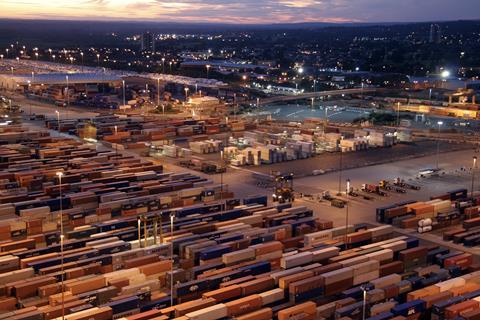
DP World has launched a new carbon inset scheme at its Southampton terminal in the UK, allowing customers to claim a share of emissions reductions generated at the port towards their own supply chain targets for the first time.
The new Container Terminal Inset Certificates are created through emissions reductions at Southampton, where the use of biofuels, such as HVO, port-wide electrification and the generation of renewable electricity has resulted in significant carbon savings.
These savings are then converted into uniquely allocated certificates that customers can use to report lower Scope 3 emissions across their supply chains.
The certificates will be included in DP World’s Carbon Inset Programme as a share of the 250kg CO2e allocation and automatically applied to qualifying cargo moving through DP World Southampton from 1 April 2026.
Customers will receive independently verified documentation to support their sustainability reporting.
DP World said that its Carbon Inset Programme, which was introduced in January 2025 in partnership with global carbon insetting platform 123Carbon, has so far registered more than 250,000 TEU of cargo in its first year, issuing over 9,000 tonnes of CO2e savings.
Originally scheduled to be a 12-month trial, the Carbon Inset Programme was subsequently extended to 31 December 2026.
“At DP World, we believe decarbonising global supply chains requires practical solutions that deliver measurable impact today,” said John Trenchard, vice-president – sustainable international supply chains, Europe.
”This scheme will turn real emissions reductions at Southampton into verified savings our customers can count towards their Scope 3 targets.
”By working with partners like Bureau Veritas and 123Carbon, we’re scaling a model that recognises the critical role ports play in driving lower-carbon logistics across road, rail and sea,” Trenchard outlined.


