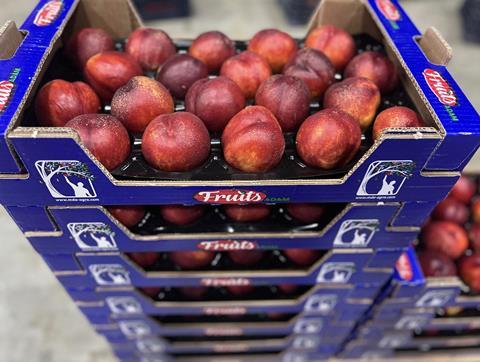
Despite rising logistics costs and regional uncertainty, Turkey’s MDA Agro is investing in new infrastructure, as it looks forward to a strong stonefruit season
Turkish exporter MDA Agro is continuing to invest in spite of the challenging global trade environment. According to owner Mustafa Arslan, the company is currently building a new facility strategically located between Mersin and Adana, Turkey’s two leading citrus and fruit-producing regions.
“We have started construction on a new facility in Tarsus Organised Industrial Zone, which is located right in the middle of these two cities,” said Mustafa Arslan of MDA Agro. “We will be located in an area close to Mersin Airport and Mersin Port.”
The location will place the company close to both winter vegetable and citrus production as well as the summer fruit regions producing nectarines, peaches, grapes and watermelons.
“With our new facility, we plan to meet standards such as IFS and BRC, and transition to a much more efficient and quality-oriented production process using next-generation technology and equipment,” Arslan explained.
The investment comes as Turkish stonefruit producers recover from the severe agricultural frosts that disrupted production last year.
“Overall, the weather conditions this season have been very favourable for fruit production,” Arslan told Fruitnet. “Fruit set was generally the same as in normal years, but after last year’s frost, it has once again reached the required level of productivity.”
Although recent rainfall briefly disrupted harvesting, Arslan said conditions were improving. “We can expect good weather and a better harvest season from now,” he noted.
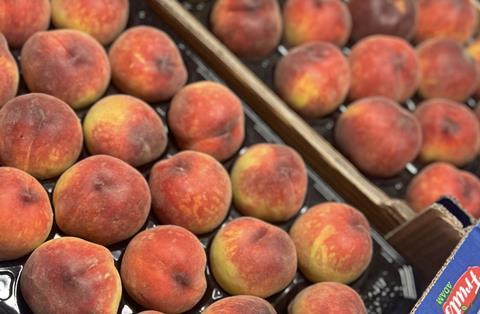
MDA Agro’s main products include nectarines, peaches, apricots and flat peaches, with nectarine varieties such as Patagonia, Copacabana, Ipanema and Boreal among its core lines. The company has also seen increasing demand for flat peaches in recent years, according to Arslan, while flat nectarine production is emerging and expected to expand in future seasons.
“While we feared sales problems with early varieties like nectarines, peaches and apricots this season, we successfully navigated this period thanks to strong demand,” Arslan said.
The company is now shipping standard varieties with improved size, firmness and shelf-life. “Turkish fruits are truly top-notch this year,” he continued. “This allows us to supply our customers with healthy products that have a long shelf-life.”
Although Russia remains Turkey’s largest export market overall, MDA Agro itself does no business there. Instead, its main destinations include Romania, Poland, Latvia, Italy and Germany, alongside air shipments to East Asian markets.
Like many Turkish exporters, however, the company continues to face rising costs and logistical uncertainty linked to regional instability. “The Iran-Israel-US conflict has already increased our major problem: logistics costs,” revealed Arslan. “We are concerned that these costs will increase even further.”
Despite ongoing economic pressures, Arslan said much of the sector had adapted through a greater focus on premium exports. “By stopping complaining and working harder, focusing on producing and exporting less but of higher quality, we minimised our losses,” he explained. “This may sound crazy, but many serious Turkish exporters have focused on this formula as the best measure against rising costs and price instability.”
Environmental conditions, meanwhile, have improved dramatically following several difficult years marked by drought, frost and extreme summer heat.
“We’ve experienced an extremely rainy period this year,” said Arslan. “For the first time in the last seven or eight years, almost all of our dams are currently at 100 per cent capacity.”
If extreme conditions can continue to be avoided, he believes prospects for next year’s citrus crop are also highly encouraging. “If cool or normal weather conditions continue throughout the summer,” said Arslan, “we anticipate a very high-quality and productive citrus season next year.”