Annual Agri-TechE conference hears challenges in turning innovation into practical solutions across the sector
Agri-tech companies waiting for “perfect” data and extending trials could be slowing the adoption of agricultural technology among farmers and growers, the 2026 Agri-TechE REAP conference has heard.
Agri-TechE is an agricultural innovation non-profit membership, which hosted its annual conference at the KingsGate Conference Centre in Peterborough on 4 November.
The event brought together farmers, researchers and tech developers to explore the opportunities and barriers to progress to technological adoption.
Many at the conference discussed how strong evidence must be in order to give farmers the confidence to invest money, time and training into adopting new technologies.
However, waiting for “perfection” in terms of gathering data and evidence could be lagging progress in adoption, the conference heard.
Dr Helen Ferrier, chair of Agri-TechE’s stakeholder group, said: “Not everything we can measure is important, and not everything that is important can be measured.”
The point was echoed by the conference’s keynote speaker, Professor Anjali Goswami, who, as chief scientific advisor at Defra, oversees the department’s £2.3bn research budget and ensures ministers have the necessary evidence to make policy decisions.
“Not every evidence gap is important,” she said, adding that with the time pressures of the anticipated ‘Super el Niño’, there is “no time to lose”.
Professor Goswami’s research background as an evolutionary biologist, which often included working with incomplete datasets, was cited as using a “good enough” approach, rather than waiting for perfect information.
Farmers speak
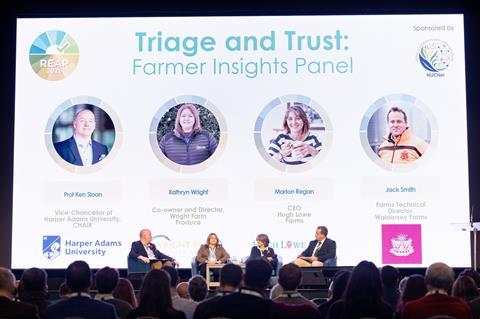
Alternatively, speakers also shed light on the realities for on-farm application. Jack Smith, technical director for Waldersey Farms, said: “New technology needs to be good enough to keep the operator still using it at 5pm on a wet Friday in November.”
Kathryn Wright, of Wright Farm Produce, added: “We need to see it working in practice - we want to touch it, feel it and smell it to give us confidence in adopting it.”
Collaboration between scientists and farmers to understand how existing farms work and what returns are needed would be key to progress, the conference heard.
Professor Cristobal Uauy, director of the John Innes Centre, suggested that agri-tech could borrow from the language of pharmaceuticals, using ‘pre-clinical’ or ‘clinical’ terminology (using the word farm instead of clinic) when discussing development stages.
Start-up showcase
Highlights of this year’s line-up included BugBug, a Bristol-based agri-tech company, who presented their AI powered acoustic sensors to detect insect and pest activity.
Biotech start-up Bug Biome was also in attendance, showcasing its solutions for microbial-based crop protection and bioinsecticides.
Swiss agri-tech company AgroSustain, which won Tesco’s Agri-tech Challenge in September, presented its edible, plant-based coating technology designed to extend fresh produce shelf life.
Other exhibitors included Australian biotech company Number 8 Bio, Cambridge-based agritech startup BindBridge, London-based Agribot and data repository platform Hazard Evaluation.