
New report expains how fruit and veg sector must overcome new, overlapping crises linked to geopolitics, economics, and climate change
Growth in the global fruit and vegetable trade has virtually ground to a halt. Between 2021 and 2025, the global trade value rose by an average of just 0.1 per cent per year, adjusted for inflation.
At the same time, geopolitical tensions, extreme weather events, and rising costs are altering the operating environment for the entire sector. What are the consequences for producers, exporters, retailers and logistics providers? And how can companies prepare for increasing uncertainties?
The new Fruit Logistica Trend Report, entitled How to weather the storm?, brings together analyses and assessments from international industry experts. Its clear message is that anyone wishing to be successful in the long term must not only operate efficiently but, above all, be able to react flexibly to change.
“The international fruit and vegetable sector has already weathered many crises,” says Mike Knowles, managing director of Fruitnet Europe and the report’s editor. ”But today’s challenges are coming faster, more frequently, and often simultaneously. Companies must therefore rethink their approach: it is no longer enough to optimise supply chains for maximum efficiency. What is crucial is to remain capable of acting even when markets collapse, harvests fail, or transport routes suddenly cease to function.”
Geopolitics is reshaping the global fruit trade
Tariffs, trade restrictions and international conflicts are increasingly calling traditional trade relationships into question. The mismatch between the pace of politics and that of agriculture is particularly problematic: whilst new tariffs can be introduced within a matter of weeks, fruit orchards take years to establish a new crop.
Companies must therefore diversify their sales markets, take geopolitical risks into account at an early stage and reduce their dependence on individual trading partners. The Fruit Logistica Trend Report also shows that markets are developing differently: whilst international trade in apples, grapes and oranges is declining, blueberries and avocados, amongst others, continue to record significant growth.
Climate change is altering growing conditions
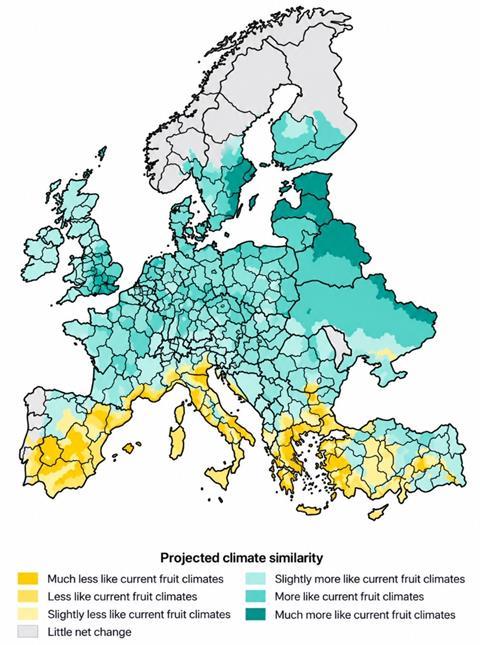
Droughts, heatwaves and changing rainfall patterns are also influencing where and under what conditions fruit and vegetables can be grown profitably. Analysis by RaboResearch shows that the climatic conditions for European fruit growing could change significantly by 2050.
Whilst parts of the Mediterranean region will suffer more from heat and water scarcity, cooler regions may become more important for certain fruit varieties.
This increases the demand for climate-resilient varieties, efficient irrigation and long-term investment decisions. At the same time, the wholesale and retail sectors are required to respond more flexibly to fluctuating harvest volumes and varying product characteristics.
Resilient supply chains are becoming a competitive advantage
International logistics also face new challenges. Low water levels – for example in the Panama Canal and on the River Rhine – as well as geopolitical conflicts and rising transport costs are jeopardising the reliability of global goods flows. For perishable goods, even short delays can result in a significant loss of quality.
The Fruit Logistica Trend Report makes it clear that, in future, it will not be solely the fastest or cheapest transport link that is decisive. Rather, it will be important to keep an eye on alternative routes, identify risks at an early stage and strengthen cooperation throughout the entire supply chain.
The report’s message is clear: the industry cannot prevent every crisis. However, companies that invest early in innovation, resilient partnerships and flexible business models create the conditions necessary to remain competitive even under uncertain conditions.
The Fruit Logistica Trend Report 2027, How to weather the storm?, was produced by Fruitnet Media International, the official and exclusive media partner of Fruit Logistica.
It can be downloaded free of charge from the Fruit Logistica website.