Leading importers reflect on how concentrated arrivals and shifting consumer psychology are redefining the rules of China’s Chilean cherry trade
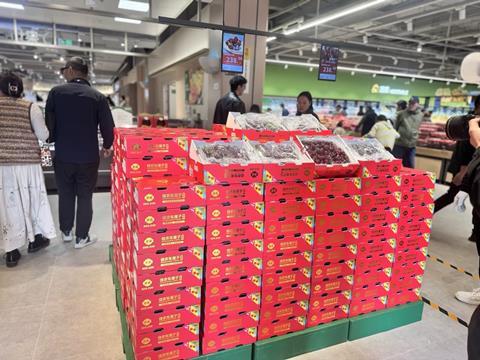
As the 2025/26 Chilean cherry season draws to a close, the Chinese market is undergoing a complex structural shift. While the industry entered the season with high expectations, the actual market performance has been affected by concentrated arrivals, the “commoditisation” of the category, and significant supply-demand imbalances.
Total Chilean cherry exports declined by around 12 per cent year-on-year, but arrival volumes were concentrated in the early part of the season, particularly December. Shipments and market supply were poorly aligned with peak demand for the later Lunar New Year on 17 February, and have struggled to build any rhythm ahead of the festivites, according to leading players.
Annie Xie, cherry product director of Goodfarmer, said the market was “bullish early on” due to quality improvements, but faced downward pressure as the season went on.
“Overall, despite the lower total volume, the fruit texture, Brix level, and shape at the start of the season showed significant improvements over the previous year, earning high market acceptance,” Xie explained.
“However, after New Year’s Day, reports of shorter production at the source led to market speculation and hoarding. This resulted in a massive backlog of containers, extending the turnover cycle to one to three weeks once they were finally opened. The extended turnover period led to a quality decline in older stock, which subsequently affected new arrivals and dragged down the overall market.”
Beyond supply-demand dynamics, a more profound change is occurring in consumer psychology. For years, cherries in China have been synonymous with winter luxury and festive gifting. In 2026, as cherries transition into an ‘everyday fruit’, this status is being recalibrated.
Raymond Mou, general manager of Shanghai Longhao Global International Trade, is keenly aware of this shift. He observes a structural transformation in this season’s cherry market.
“Cherries have become a regular commodity rather than an unreachable luxury,” said Mou. “The old logic of ‘scarcity drives value’ no longer applies. We are seeing an industry inflection point where consumers are becoming more rational, and tighter purse strings are influencing purchasing decisions. We cannot blame quality, purchasing power, or volume in isolation; it is a market reaction triggered by a convergence of factors.”
Despite the focus on value, the market is seing a clear ‘quality polarisation’. Feedback from the retail sector indicates that while the 2J size remains the primary choice for cost-conscious families, preference for premium 3J and 4J sizes continues to grow among consumers seeking a ‘guaranteed experience’, according to Xie.
“Compared to last season, overall sales velocity increased due to moderate price adjustments, and the proportion of ‘full-box’ purchases for household use rose significantly. Cherries are accelerating their transition from a festive gift to a daily premium staple,” she said. “Consumers are clearer in their choices: demand for cost-effective 2J mainstream fruit is stable, while the preference for high-quality 3J and 4J sizes is growing. Quality assurance and consumer experience remain the core market demands.”
With over 90 per cent of the season’s volume already at ports and supply expected to tighten as Chinese New Year approaches, major importers are pivoting to clear remaining inventories. Goodfarmer has launched a ‘Gift Festival’ to stimulate demand through origin storytelling and enhanced offline experiences.
“We have significantly enhanced the experiential atmosphere at offline retail outlets while linking with online influencers for themed interactive content marketing to create a traffic loop,” Xie explained. “By sharing origin stories and quality standards, we are strengthening consumer recognition and pre-holiday demand, helping consumers associate our products with a quality lifestyle and emotional connection, which supports a reasonable brand premium.”
Looking ahead to next season, industry leaders agree the current model must evolve. Mou cautions that the “market temperature” for cherries failed to reach previous levels this year.
“The anticipated pre-season sales momentum suddenly evaporated. By the time the market was ready to move, both quality and volume failed to keep up. We have many lessons to learn for the next season,” he said.
Xie emphasised that closer synergy with Chilean exporters regarding data transparency and shipping schedules will be vital.
“We aim to drive closer cooperation in three areas,” she concluded. “First, establishing high-frequency data sharing to align shipping rhythms with peak consumption periods and smooth out fluctuations. Second, optimising variety structures to focus on fruit with better firmness, Brix, and shelf-life. Finally, working with e-commerce platforms to establish strict quality labelling and traceability standards to protect the ‘premium quality for premium price’ environment and achieve a win-win for the industry.”


