Fruitnet Citrus Congress hears how business as usual is no longer an option as a commodity-led approach is putting the future profitability of the category at risk
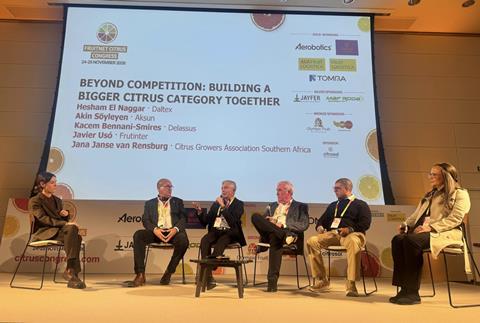
The citrus industry needs to work more closely together if it is to protect margins, stimulate consumption and secure its long-term future. That was the overriding message from this week’s Fruitnet Citrus Congress, where speakers called for a more collaborative approach to tackling the challenges facing the global business.
With production costs rising, climate pressures intensifying and competition between suppliers putting further strain on returns, delegates heard that the industry must move away from fighting over an increasingly squeezed market and concentrate instead on growing the overall value of the category.
The message was particularly strong during a panel discussion featuring leading international suppliers from Spain, Egypt, Morocco, Turkey and South Africa, who agreed that greater coordination between producing countries was essential.
Javier Usó of Spain’s Frutinter highlighted the difficulties created by overlapping supply seasons, arguing that countries needed to work together rather than compete for the same market opportunities. “It’s about making the cake bigger so that we can all have our slice,” he told the panel.
Usó called for greater reciprocity and transparency around volumes, while Jana Janse van Rensburg of Citrus Growers of Southern Africa said suppliers need to work together to ensure that the right fruit reaches the right market at the right time.
Hesham El-Naggar of Egypt’s Daltex echoed that view, warning that citrus had become too much of a commodity, with margins now too small to sustain the business in its current form. “We’re not here to fight over a smaller pie. It’s about growing the market for all of us,” he said. “We have become a commodity and we’ve got to change that.”
El-Naggar argued that suppliers had a responsibility to deliver greater consistency, helping retailers manage their sourcing more effectively and ultimately serve consumers better. The industry, he said, needed to shift its focus away from competing with one another and towards building demand.
The same view was reiterated by Lloyd Thompson of Marks & Spencer and Tesco’s Maria Katsipi, who stressed that consistency remained fundamental, particularly in the UK market. “If a consumer has a bad experience you can lose them for 12 weeks,” Thompson warned.
Both Thompson and Katsipi said retailers needed a balanced sourcing approach, with suppliers identifying the right opportunities within the 52-week calendar. This required closer working relationships between growers, breeders and retailers, as well as greater transparency around pricing and production challenges.
Thompson also emphasised the importance of maintaining a reliable core offer throughout the year before introducing more innovative products to generate excitement. Distinctive varieties, interesting flavour profiles and products that look different could all help reinvigorate consumer interest.
Kacem Bennani-Smires of Morocco’s Delassus told the congress that collaboration had to extend throughout the value chain, with growers, suppliers and retailers all playing their part. He pointed to other categories, including kiwifruit and avocados, as examples of how collective efforts could help drive consumption.
“Let’s learn from kiwifruit and avocados and other categories when it comes to working together to get people to eat more citrus,” he said.
He also emphasised the importance of sustainability as a pre-competitive issue, urging retailers to recognise the investment suppliers were making in this area.
Janse van Rensburg summed up the sentiment: “Competition is good. But we need to collaborate more, to work together and for the greater good. Sharing market information, for example, is something that would help us all.”
Asked if she thought phytosanitary complaints raised by EU growers over issues such as citrus black spot, false coddling moth, or pesticide residues exceeding MRLs were being used to prevent fair competition, she said it was vital that regulatory requirements are science-led rather than driven by politics or emotion.
The need to protect profitability was reinforced by market analyst Cindy van Rijswick, whose presentation, Bittersweet Citrus Symphony, examined the economic and structural pressures facing the sector.
Although citrus demand remains relatively stable, she noted that the category operates in a challenging environment of flat food sales, price-conscious consumers and fierce competition between retailers. Rising production costs and increasing pressure on margins are compounded by climate change, particularly heat stress and worsening water availability.
Van Rijswick warned that citrus production in Europe is likely to decline further, having already fallen below levels seen a decade ago. With growers facing difficult investment decisions and alternative crops potentially offering better returns, the industry needs to take action to prevent further contraction.
“Sustaining margins requires investment,” she said, highlighting the particular difficulties facing smaller farms, especially in Spain, where more than 70 per cent of holdings are smaller than 5ha.
Her conclusion was that opportunities remain for citrus, but the companies able to invest in addressing rising costs and production challenges will be best positioned to benefit.
The importance of a joined-up approach was also a recurring theme in a panel discussion involving Thompson, David Alba of Genesis Fresh and Hugo A-Tjak of Olympic Fruit.
For Alba, the industry needed to focus on three key areas to attract consumers: consistency, convenience and what he described as the category’s ‘cool factor’. Citrus, he argued, has become a mature category that risks being overlooked by younger consumers, despite opportunities to develop more attractive, convenient and exciting products.
A-Tjak highlighted the need to broaden the consumer base, particularly in markets where citrus purchases are heavily concentrated among older shoppers. Making fruit easier and more enjoyable to eat, including addressing younger consumers’ concerns about the messiness of peeling oranges, could help unlock new demand.
Ultimately, the congress highlighted that citrus remains a vital category with considerable potential, but that its future cannot be taken for granted. New varieties, improved production methods, more effective marketing and better supply-chain coordination will all be needed to address the challenges ahead.
The message from all of this year’s speakers was clear: protecting the future of citrus means looking beyond individual seasons, countries and commercial relationships. By sharing information, coordinating supply and working together to grow consumption, the industry has an opportunity not only to defend its margins, but to create a bigger and more valuable market for everyone.
Beyond the discussions on collaboration and profitability, the congress also explored a broad range of issues shaping the future of the citrus business. Talks included Paco Borrás analysing Spain’s changing competitive position in the global market; branding expert Nuria Pizan discussing how to reinvigorate consumer demand through more effective marketing and attract younger shoppers, and José Antonio Garcia of Ailimpo, Peter Bouman of The Sour Supplier by FMI and Nicci Stewart of SummerStar Ruby highlighting the growing opportunities in lemons, limes and grapefruit respectively.
Delegates also heard about greener post-harvest solutions, more sustainable and dependable supply chains, and the potential of new transport technologies, including rail. Looking further ahead, Siebe van Wijk of The Fruit Republic examined Vietnam’s emergence as both a potential supply origin and growth market, Nanovel’s Isaac Mazor presented the prospects for robotic harvesting to address labour shortages, Javier Meca of Jayfer Technology and Cristina Benedit of Fibercell presented a pioneering new technique in tree production to improve efficiency and reduce disease risks, and Oscar Olivares showcased the work being done by the Todolí Foundation to protect biodiversity and find innovative applications for citrus in science, gastronomy and industry.