The variety, which ripens earlier than Navelina, is the first of three to be launched with the aim of securing an eight-month supply window
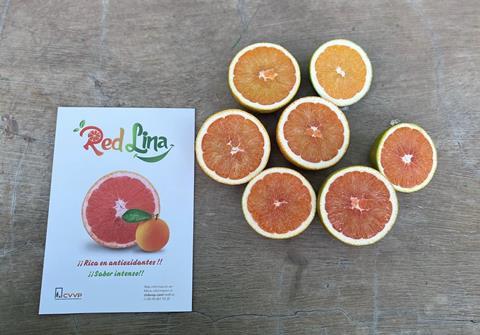
Citrus Rosso has held a series of field events to demonstrate the performance of Red Lina – the first variety in its pigmented orange designed to span an eight-month commercial season.
Growers, technical experts, and commercial operators had the opportunity to see the variety’s performance first hand at farms in Valencia, Huelva and Sevilla. The visits included tours of the orchards, fruit tastings, and an analysis of the variety’s agronomic and commercial data, gathered over six seasons of observation in Spain.
Red Lina originated from a spontaneous mutation of the Navelina variety, discovered in South Africa in 2009. According to Citrus Rosso, its primary advantage is its earliness: in the earliest-ripening regions, it matures three to four weeks ahead of the Navelina, while in mid-to-late-season areas, it ripens about two weeks earlier – making it available throughout October, November, and December.
The fruit is more rounded in shape and features a skin with a distinct reddish hue. Internally, it combines lycopene – which gives it its red colour – with an exceptionally high concentration of beta-carotene, positioning it as a health-promoting food.
“In terms of flavour, it is notable for its aromatic profile – the result of a high concentration of volatile compounds – and for maintaining a stable balance between sweetness and acidity throughout the entire harvest period,” Citrus Rosso said.
Moreover, its developers said the variety demonstrates good natural resistance to fruit drop and the loosening of the fruit’s “nipple”, eliminating the need for hormonal treatments and allowing the fruit to remain on the tree for longer; no instances of clareta, a physiological disorder causing rind breakdown; and denser foliage and shorter internodes, resulting in approximately 20 per cent more buds per cubic meter of the tree canopy, which can translate into up to 20 per cent more fruit.
According to Citrus Rosso, Red Lina is not intended to be a direct replacement for Navelina, but rather as a distinct offering in its own right. “The goal is to provide something unique that appeals to consumers through its appearance, flavour, and freshness, helping to reignite interest in the category,” it said.
Citrus Rosso, which holds the exclusive license for the entire Mediterranean basin, aims to license 1.5mn trees, with Spain as its priority market. This scale would allow for a field harvest of approximately 70,000 tonnes, exceeding the roughly 50,000 tonnes of marketable fruit typically required by supermarket chain procurement programmes.
Red Lina paves the way for a more ambitious plan by Citrus Rosso to carve out a space in the market for red-fleshed oranges. It said simply launching a single variety is not enough – rather a broad assortment is required to secure a permanent place for this type of fruit on supermarket shelves.
To achieve this, two additional varieties are currently under development. Together with the existing one, they would allow red oranges to be available on the market for about eight months of the year.