Sector said pest has caused losses of 360,000 tonnes or €540mn since 2022/23
The Association of Fruit and Vegetable Producer Organisations of Almería (Coexphal) has put out an urgent plea to Spain’s agriculture minister for assistance in tackling the pepper thrips pest, which has caused widespread damage to production in the province.
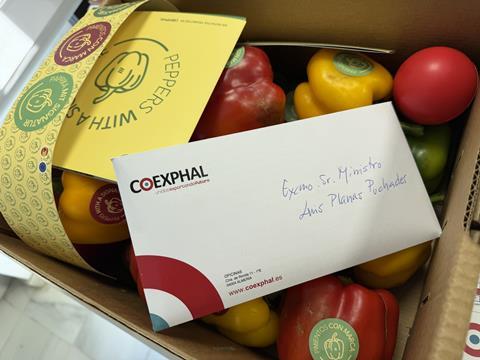
It has sent a letter to Luis Planas, accompanied by a box of peppers affected by the pest and materials from its ‘Peppers with Marks’ (Pimientos con Marca) campaign – an initiative launched by the organisation to draw attention to the damage this insect is causing to one of Almería’s most important crops.
“Growers want to convey to the national government the gravity of a situation that is already having significant economic and production-related consequences for the sector,” Coexphal said. “They are also calling for the adoption of extraordinary measures to supplement the biological control tools currently being used to combat the pest.”
Titled ‘Mr Minister, don’t you like peppers?’, the letter invites the government to reflect on its response thus far to a phytosanitary threat that has mobilised the entire sector.
Coexphal clarified that the sector is not requesting permanent exemptions, nor is it questioning the European model of reducing active substances; but rather calling for exceptional measures to be adopted given the gravity of the situation.
“It is important for the Ministry to join the sector’s efforts in seeking solutions to support the primary crop of Almería province – a crop that is also one of the most significant in all of Andalusia,” it noted.
In recent years, Almería’s horticultural sector has implemented an intensive strategy to contain and manage pepper thrips – also known as thrips parvispinus. Measures taken include strengthening preventive actions on farms, increasing technical advisory support for farmers, continuously monitoring pest hotspots, disseminating protocols for the proper management of plant debris, and organizing technical workshops for knowledge transfer.
Furthermore, the sector has intensified the rollout of biological control programmes – a hallmark of Almería’s production model. This is particularly evident in pepper cultivation, where integrated pest management is practiced on 99 per cent of farms.
Another significant decision taken by the sector is the proposal for an extraordinary “biological break” (a temporary suspension of cultivation) across large production areas. The sector has embraced this measure – despite the high economic cost involved – with the goal of reducing the pest population pressure between growing seasons.
The letter also highlights the establishment of the Plant Health Roundtable, an initiative led by the Regional Government of Andalusia that includes other agricultural organisations. This effort involves ongoing collaboration with researchers, technical experts, and producers to improve strategies for the detection, prevention, and control of the insect.
“It would be beneficial for the Ministry of Agriculture to join this technical roundtable and actively participate in finding solutions,” Coexphal said.
An economic assessment of the impact the pest is having on pepper cultivation undertaken by Coexphal shows that the production and sale of peppers has been declining by an average of 10 per cent each season since 2022/23 – a result of both the uprooting of existing crops and the decision not to plant new ones, due to the difficulties in controlling the pest.
Cumulatively, this situation amounts to a loss of 360,000 tonnes of produce over the last four seasons, equivalent to approximately €360mn at the point of origin and around €540mn at the destination.
According to Coexphal, these figures demonstrate that the pepper sector in Almería is facing one of the most challenging periods in its recent history. It underscored the need to strengthen the available tools to combat a pest that threatens the profitability of farms, the survival of many businesses, and the competitiveness of a product that is strategically important for Spain within European markets.
“It is essential that all government authorities – including the Ministry of Agriculture – engage with equal determination to safeguard the future of one of the key products from one of the most significant sectors of Spanish agriculture,” Coexphal said.