Two countries forge alliance to develop bananas resistant to Fusarium and Moko disease
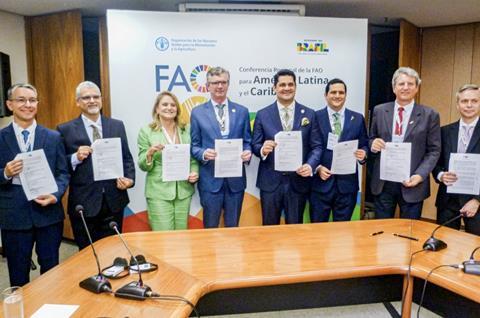
The Association of Banana Exporters of Ecuador (Aebe) and the Brazilian Agricultural Research Corporation (Embrapa) have signed a deal to develop banana varieties resistant to the main pests affecting plantations. The five-year project will focus on developing Cavendish cultivars resistant to Fusarium wilt TR4 and Moko disease.
The signing of the agreement took place at the headquarters of the Brazilian Ministry of Foreign Affairs, with the participation of Embrapa president Silvia Massruhá; Ecuador’s Minister of Agriculture, Juan Carlos Vega; Aebe executive director José Antonio Hidalgo; and the association’s president, Jorge Encalada.
According to Aebe, the alliance represents a direct and urgent response to the phytosanitary threat posed by Fusarium wilt, which had been present for several years in various Latin American countries but was detected for the first time in Ecuador last December.
The first reported cases of TR4 in Latin America were in Colombia in 2019. Since then, the disease has spread to Venezuela, Peru and now Ecuador, despite the latter implementing strict biosecurity measures to delay the entry of the fungus.
Aebe warned that Fusarium wilt could have a potentially devastating impact on Ecuador’s economy, since around 250,000 direct jobs depend on the banana industry and the fruit one of the main pillars of the country’s non-oil exports.
“Therefore, the development of new genetically resistant varieties is emerging as one of the only viable alternatives for the industry,” Encalada said, highlighting the importance of the alliance with Embrapa.
Following the detection of Fusarium wilt in Ecuador, the national approach has focused on containing and excluding the outbreak through phytosanitary cordons and specialised brigades. “Currently, the strategy combines mandatory compliance with biosecurity measures on farms with a strong commitment to science and innovation,” Hidalgo explained.
During their visit to Brazil to sign the agreement, the Aebe delegation met with Embrapa’s executive director of research and development, Clenio Pillon, as well as with researchers from Embrapa Cassava and Fruit Growing, who are responsible for the banana genetic improvement programme.
They also visited the National Centre for Genetic Resources and Biotechnology (Cenargen) in Brazil, where they learned about the facility’s scientific capabilities in plant genetics and the conservation of plant genetic resources.