While other sectors will see bigger wins, the fresh produce business is set to benefit through lower duties, smoother trade and stronger IP protection
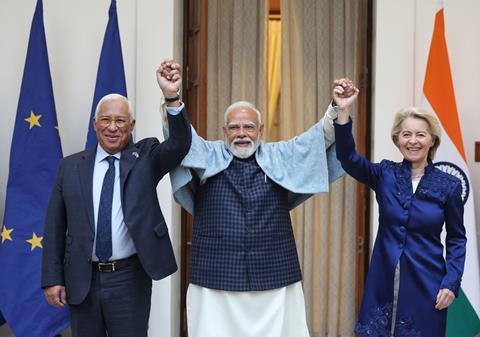
The European Union and India have announced a landmark trade deal after almost two decades of on-and-off negotiations.
The deal will allow free trade of goods between the bloc of 27 European member states and India, respectively the world’s second- and fourth-largest economies. Together, they represent a market of almost 2bn people and account for nearly 25 per cent of global GDP.
EU-India trade in goods and services currently exceeds €180bn (US$197bn) per year, according to a press release from the European Commission. The deal is expected to double EU goods exports to India by 2032 by eliminating or reducing tariffs on 96.6 per cent of exports, it said. Overall tariff reductions are set to save around €4bn (US$6.87bn) in duties.
Meanwhile, the EU will reduce or eliminate tariffs on 99.5 per cent of goods imported from India over seven years, India’s Ministry of Commerce and Industry said.
European Commission (EC) president Ursula von der Leyen described the agreement as “the mother of all deals”.
“The EU and India make history today (27 January), deepening the partnership between the world’s biggest democracies. We have created a free trade zone of 2bn people, with both sides set to gain economically. We have sent a signal to the world that rules-based cooperation still delivers great outcomes.”
Indian Prime Minister Narendra Modi also hailed the historic nature of the agreement.
“This is India’s biggest free trade agreement,” he said. “It will make access to European markets easier for India’s farmers and small business. It will also boost manufacturing and services sectors. It will boost innovative partnerships.”
Under the agreement, India will grant the EU tariff reductions not previously offered to other trading partners, according to the EC. Tariffs on cars will be reduced from 110 per cent to 10 per cent over five years. Tariffs ranging up to 44 per cent on machinery, 22 per cent on chemicals and 11 per cent on pharmaceuticals will also be mostly eliminated.
India is also slashing tariffs on alcoholic beverages like wines from 150 per cent to 75 per cent with immediate effect, then gradually to 20 per cent.
Meanwhile, the Indian government said that almost all its exports would enjoy “preferential access” into the EU, with textiles, leather, marine products, handicrafts, gems and jewellery set to see a reduction or elimination of tariffs.
Guarded approach on agri-food trade
While agri-food trade is also set to benefit from the FTA, both sides have moved to protect so-called “sensitive” sectors.
From the EU side, products such as beef, chicken meat, rice and sugar are excluded from liberalisation in the agreement. All Indian imports will also continue to be subject to EU health, plant protection and food safety rules.
Meanwhile, the Indian government said it had “prudently safeguarded sectors including dairy, cereals, poultry, soy meal and certain fruit and vegetables, balancing export growth with domestic priorities.”
The EC said the agreement removes or reduces tariffs on EU agri-food exports that currently average over 36 per cent.
“Positive news” for fresh produce business
Key figures in the fresh produce industry reacted positively to the announcement of the free trade agreement.
“After the uncertainties on the ratification of Mercosur and the geopolitical turmoil impacting pre-visibility, the agreement between the EU and India can be welcomed as positive news for the fresh produce business,” said Philippe Binard, general delegate of Europe’s fresh produce industry association, Freshel Europe.
“Despite some exclusions on both sides in sensitive areas such as rice, dairy, sugar, bananas or garlic, the agreement for EU export will lead to some interesting duty reductions, even if some of them will be within tariff-rate quotas (TRQ) that widely reflect existing trade.
“For exports from India to the EU, the benefits of tariff reductions will be more marginal as many Indian products were already enjoying GSP duty exemption. With regard to table grapes, a preferential TRQ corresponding to the current trade flow will lower tariffs during the export season.”
Azhar Tambuwala of major Indian producer-organisation and exporter Sahyadri Farms said the tariff reductions were a timely boost.
“The duty benefits are long-awaited as other supply origins have been on zero duty and making India less competitive,” he told Fruitnet. “Duties on products like grapes, cucumbers, and dried onions, which previously faced tariffs of up to 17 per cent – will be eliminated or significantly reduced. We did have preferential tariffs reducing the regular duty on grapes though.”
Table grapes curently account for more than 80 per cent of India’s fruit exports to the EU, reaching almost 134,000 tonnes in 2024 and increasing at a CAGR of 14 per cent over the five-year period from 2020-2024, according to Fresh Intelligence analysis. Mangoes and pomegranates make up the remainder, with shipments of 19,607 tonnes and 4,101 tonnes in 2024.
Duties slashed for EU pears and kiwifruit
Turning to EU fruit exports to India, import tariffs on kiwifruit and pears, currently set at 33 per cent, will be cut to 10 per cent in-quota, according to an EC factsheet. While EU apple exports to India are subject to a tariff of 50 per cent, it is understood this will be reduced to 20 per cent within a seasonal TRQ. Other products, including berries, selected vegetable lines and mushrooms, are also set to benefit from tariff reductions.
Apples accounted for more than 90 per cent of EU fruit exports to India in 2024, although volumes fluctuate and fell almost 40 per cent year-on-year to 56,717 tonnes in 2024/25. Kiwifruit exports dropped by 80 per cent to 4,268 tonnes, making up 7 per cent of total fruit exports.
Beyond lower tariffs, the fresh produce industry is also hopeful the FTA will facilitate swifter negotiation on sanitary and phytosanitary agreements, and simplify customs procedures to make exports quicker and easier.
The agreement also boosts protection and enforcement of intellectual property rights, including plant variety rights. This is a welcome development for the fresh produce business, as international companies look to market trademarked brands in India and license their genetics in the country to capitalise on India’s potential as a production hub.
EU companies are also expected to benefit from broader access to India’s services markets, including sectors such as logistics and marine transportation.
In parallel with the free trade deal, the EU and India are also negotiating a separate geographical indications (GIs) agreement. The EC said the agreement would help traditional iconic EU farming products sell more in India by removing unfair competition in the form of limitations.
The agreement also includes commitments to sustainability, climate policy and labour rights, together with an EU-India cooperation plan on climate action, which is expected to launch in the first half of 2026.
Next steps
The negotiated draft texts of the free trade agreement will now undergo legal revision and translation before being submitted to the EU Council to sign and conclude the agreement. At that point, the EU and India can sign the agreement, and once ratified by the European parliament and India, the FTA can enter into force.
A formal signing of the deal could come later this year, although industry sources said the process “could take some time”.