initiative seeks to integrate industry data to strengthen decision-making and boost table grape consumption
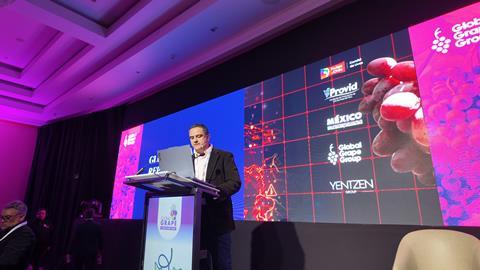
The Global Grape Group (GGG) has presented its first statistical report at this week’s Global Grape Convention in Santiago, Chile. The alliance, established in 2025 by trade organisations from Chile, Peru, and Mexico, aims to develop joint actions to strengthen the category and promote consumption in the US – the biggest export market for all three countries.
Presenting the report, Álvaro Aspée, executive director of the Table Grape Committee of Frutas de Chile, and Pablo Cortés, commercial manager at Agronometrics, said it was a valuable tool in overcoming data fragmentation – often split by country or season – that would strengthen strategic decision-making for an industry that has undergone profound transformations.
“The table grape sector has changed immensely. Today, we have new origins, new varieties, higher productivity levels, and a supply that increases practically year-round,” Aspée said.
“However, much of the information remains fragmented, and we often make decisions without a complete picture. That is why we believe the time has come to view this industry in a global, strategic way, and this first report is a fundamental part of that effort.”
The report shows that between 2017 and 2025, the combined supply of table grapes from Chile, Peru and Mexico to the US market grew by 41 per cent, equivalent to nearly 30mn additional cartons. By contrast, demand growth hovers at around just 3 per cent, highlighting the need to develop strategies to boost consumption.
Aspée noted that per capita table grape consumption has remained broadly stable at between 3.6 and 3.7kg over the last two decades, with an unprecedented jump to 4.3kg in 2024.
He said the report would enable better management of supply peaks in the US – a market that is considered to be able to absorb is 3.5mn cartons per week. GGG said this threshold was exceeded during two weeks in the 2023/24 season, 11 weeks in 2024/25, and 13 weeks last season. Furthermore, the report will incorporate global data on acreage, varieties, production, exports, imports, trade flows, and supply windows, facilitating more strategic decision-making.
According to Cortés, there are 1.98mn hectares of table grapes planted globally, producing in excess of 35mn tonnes a year.
Manuel Izaga Díaz, president of Provid Peru, emphasised the importance of aligning concepts and understanding the diverse production models found in each region of origin.
“Today, we continue to work day-to-day across three countries, but this is a global effort that we hope more stakeholders will join. Although business models differ by nation, the Global Grape Group has been established to contribute, share information, and understand the path forward,” he said. He urged participants to leverage the group’s work to break with historical inertia and share market intelligence for the benefit of the entire industry.
Iván Marambio, president of Frutas de Chile, pointed out that the GGG alliance was all the more necessary given the turbulent international geopolitical landscape. He described Mexico, Peru, and Chile as the “middle powers” of the global fruit industry.
“In a world where everything is changing, ‘middle powers’ cannot remain idle or blindly align themselves with dominant blocs. The best response is for similar countries to engage directly with one another on a sectoral basis,” he said.
“We believe that joint action by Chile, Peru, and Mexico is the path to expanding our industry and defending the table grape category in the US and globally.”
The full report will be officially launched in Spain in the coming months.