Shipping giant sees revenue fall to US$12.97bn and EBITDA drop to US$1.75bn in the opening quarter of 2026
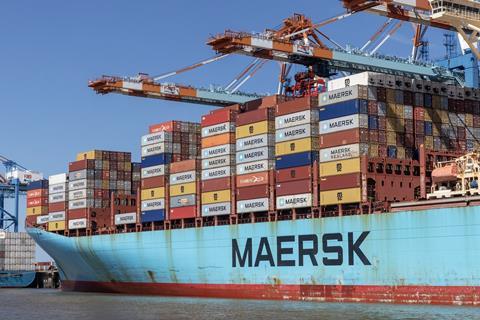
AP Moller-Maersk has announced its results for the opening quarter of 2026 (Q1), with year-on-year decreases in revenue and underlying profit.
The shipping giant’s revenue fell from US$13.32bn last year to US$12.97bn, attributed to lower freight rates.
EBITDA dropped from US$2.71bn to US$1.75bn, it reported, with underlying profit down from US$1.15bn in 2025 to US$171mn.
The group stated that, against a volatile geopolitical environment, demand for container trade further increased in the quarter, supported by ”robust export growth out of China”, which accelerated relative to the previous quarter.
The outbreak of the conflict in the Middle East had limited impact on demand and financial performance for the first quarter, it confirmed.
Maersk said it ”delivered solid first quarter results with EBIT of US$340mn, driven by strong volume growth across all businesses, continuous operational improvements, and cost containment measures”.
It pointed to the ocean sector outperforming the market by growing volumes 9.3 per cent, logistics and services revenue rising 8.7 per cent while continuing to improve margins, and the terminal segment lifting volumes by 4.3 per cent.
”We’ve seen strong demand across most regions this quarter, supporting robust volume growth in our three business segments,” outlined Vincent Clerc, CEO at Maersk.
”In Ocean in particular, market volatility remains high and industry oversupply continues to put pressure on rates.
”In this environment our disciplined focus on cost management contributes to resilient performance,” he continued.
”At the same time, our flexible ocean network continues to prove its value as a true gamechanger, lowering our ocean unit cost by 7 per cent even as the Middle East conflict disrupted supply chains.
”We also continue to see profitability momentum in terminals and most parts of logistics and services,” Clerc commented.
”This performance strengthens our competitiveness and our ability to support customers reliably through continued uncertainty in the global environment.”