The Avocado Congress heard that Europe’s avocado market grew 16 per cent in volume in 2025 and still holds significant potential

The World Avocado Organisation (WAO) held the latest edition of the Avocado Congress in Madrid this week, focusing on some of the key issues that will shape the future of the category.
Taking place ahead of Fruit Attraction, the event looked at the evolution of global supply, the growth potential of the European market, changing consumer demands and the role of different producing countries.
It also coincided with the tenth anniversary of the WAO, following a decade marked by ”sustained category growth and the increasing integration of avocados into the consumption habits of European households”.
Growth potential
Data presented during the Congress showed that avocados continue to follow a strong growth trajectory globally and that, despite the rise seen in recent years, the European market still has ”significant potential”.
Eric Imbert, researcher at Cirad, opened the discussion by highlighting avocados as the most dynamic category among the world’s ten largest fruit markets by volume.
In just a decade, the market has doubled in size, with average annual growth of approximately 7 per cent.
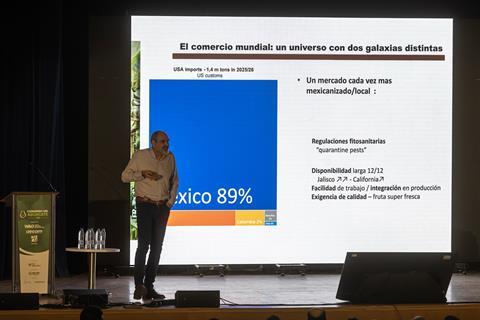
Despite this growth, global demand remains highly concentrated. More than 80 per cent of global Hass avocado trade is destined for North America, the EU and the UK, which remain the category’s leading markets.
Imbert noted that these will remain the main drivers of the market in the medium term, although they are increasingly operating independently.
While the US and Mexico increasingly operate as a single market, Europe is facing greater economic pressure and the simultaneous arrival of avocados from multiple origins.
This situation, already seen during the summer, will continue into the coming winter season, making quality increasingly important, he said.
“Avocados continue to show very dynamic growth globally,” Imbert noted. ”The market has doubled over the summer in just ten years, and the outlook remains positive.
”However, we are entering an increasingly complex phase, particularly in Europe, where more origins and supply calendars are overlapping.
”Maintaining quality and promoting to consumers would be essential to support the continued growth of the category,” he said.
These prospects build on the strong results recorded in 2025, when the European market grew by an average of 16 per cent in volume, and average consumption across the EU reached 1.8kg per capita.
Meanwhile, David Magaña, senior vice-president and senior analyst at Rabobank, analysed some of the key macroeconomic factors shaping the evolution of the global market.
According to the data presented, global avocado exports have quadrupled over the past 15 years and are expected to continue growing.
This expansion is also reflected in the number of countries participating in the international market.
In 2014, only 12 countries exported more than 5,000 tonnes of avocados, compared with 22 in 2024, and Rabobank estimates that this figure could reach 30 by 2030.
In Europe, avocados remain a relatively new fruit for many consumers compared with other fresh fruits, meaning that per capita consumption still has room to grow.
Total avocado supply in the EU has increased fivefold since 2012, reaching 1mn metric tonnes in 2025.
Looking ahead, an increase of just 100g in annual per capita consumption would raise total demand to 1.47mn metric tonnes by 2035.
Magaña also highlighted some of the external factors that could affect the market in the coming years, including price developments and climate events such as El Niño.
Consumer habits
Alongside the evolution of supply, another key topic at the event was the need to better understand consumers to continue driving category growth.
Shelly Vorster, managing director of the WAO, noted the results of research involving more than half a million consumers.
The findings pointed to two clear conclusions, she said: the consumers driving category growth vary considerably from country to country, and higher incomes do not necessarily mean higher avocado consumption.
Age, household type, eating habits and the way avocados are consumed vary ”significantly” from one market to another, Vorster noted, while the way avocados are consumed also varies by country.
Despite these differences, health remains the number one reason for buying avocados in the ten European markets analysed, regardless of consumers’ age, lifestyle or socioeconomic status.
“The data shows us that there is no single European avocado consumer,” she told those in attendance.
”The profiles driving category growth are very different from country to country and are not determined by income alone.
”This highlights the importance of understanding who our consumers are, what stage of life they are at and how they incorporate avocados into their diets,” Vorster pointed out.
”This is fundamental if we are to adapt our approach and continue driving demand in each market.”
Future of the category
The Congress continued with two panel discussions focusing on some of the key challenges and opportunities shaping the future of the category.
The first roundtable looked at the importance of turning growing interest in avocados into long-term consumption habits.
Factors such as maintaining consistent quality, offering the right level of ripeness and ensuring year-round availability were seen as essential to turning a first purchase into a regular consumption habit.
The discussion also considered making it easier for consumers to choose and consume avocados, and suggested how innovation and avocado-based products can help create new consumption occasions and respond to changing consumer needs.
Participants also highlighted the importance of collaboration, transparency and trust throughout the value chain in responding to consumer expectations and continuing to drive category growth.
A second roundtable honed in on the production outlook in the main avocado-supplying countries, looking at how the current season is developing, expectations for the year ahead and the potential impact of weather patterns such as El Niño.

Panellists noted that supply outlook goes beyond farm-level production, with factors including fuel costs, logistics, distribution, and the wider economic environment all influencing the volumes and quality ultimately reaching European consumers.
Despite the uncertainty surrounding individual production forecasts, producing countries remain confident in their ability to supply global markets.
While weather-related events such as El Niño may create fluctuations from one season to another, the broader long-term outlook remains positive, with global avocado volumes expected to continue growing.
Producing countries are also drawing on their experience, planning capabilities and tools to prepare for and manage the effects of climate variability.
The panel highlighted that greater collaboration between producing countries and the industry as a whole will be essential to address future supply and demand challenges.
Ensuring a consistent supply and maintaining quality requires greater coordination between different origins, they added.