European trade representative says climate is making risk management increasingly difficult, as competition with North Africa intensifies
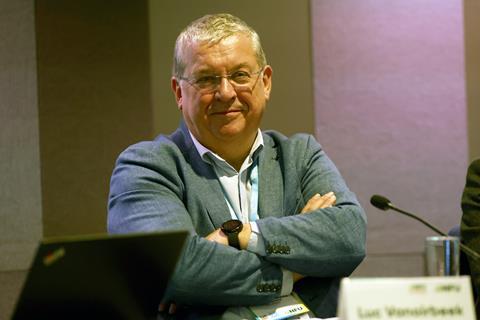
Climate change is the number one challenge facing European fruit and veg producers, according to the secretary general of Belgium’s fresh produce trade body VBT.
Luc Vanoirbeek, who also chairs Copa-Cogeca’s fruit and vegetables working group, was speaking at the NFU Conference this week as a keynote address in the breakout session for horticulture and potatoes.
“Climate is, as far as I’m concerned, the main challenge,” he told the room. “Approximately every month it is here,” he said, noting severe flooding in the south of Spain that has decimated harvests as one example.
“It’s really devastating and it’s changing our business. To give you an idea of impact, a storm in Slovenia caused the damage of 11 per cent of their GDP. We have to act and we have to act very fast. We will be the first victims of those things.”
He pointed to risk management as one of the ways climate is impacting growers as insurance becomes difficult to obtain. “In the EU, approximately 20 per cent of those in horticulture are insured,” he said.
“This is something completely dangerous. I don’t want to exaggerate, the only thing I want to avoid is those events will cause failures and bankruptcies.”
After climate, Vanoirbeek listed plant protection products, markets, society and politics as the top five challenges facing his sector.
He warned growers are facing increased threats from pest and disease, driven by a changing climate, while the amount of chemical plant protection products declined by 50 per cent between 2011 and 2024.
“We are reaching really the bottom of our toolbox. We are not able to fight any new pests or disease, while the number of pests is rising,” he said.
“It takes 15 years to approve a new product in Europe, compared to other continents where it is five or seven years. This is really putting us backwards.”
He also highlighted growing competition with North Africa, particularly in Morocco and Egypt, where energy costs are extremely low and investment in high quality production is increasing.
“I was in the region of Agadir recently and they are really building greenhouses and doing a great job. Everything is Global-GAP assessed, with low or no energy costs. We can’t compete with that,” he said.
“I thought they wouldn’t make it because they have no water. I don’t want to spoil your congress but they are taking the water out of the sea and building huge installations. Please get real, the competition will be tougher in the future,” he said.
NFU fighting ‘tooth and nail’ on EPP
Chair of the NFU’s horticulture and potatoes board, Martin Emmett, has welcomed progress in communicating to Defra how the proposed Employer Pays Principle (EPP) threatens fresh produce suppliers.
Speaking in the horticulture and potatoes breakout session at the NFU Conference this week, Emmett said: “The progress that we’ve made with Defra is that they agreed that it wasn’t appropriate that EPP was a mandatory payment.
“It’s a completely inappropriate standard, so we are fighting this tooth and nail. It is something of an ideological battle. We are talking actively to Sedex and they are doing a consultation on this,” he said, urging delegates to provide feedback on the consultation (available online).
“Perhaps the main story we’re looking at is the Farm Profitability Review by Baronness Batters,” continued Emmett, who called the government’s plan to create its first sector plan in horticulture as “really encouraging”.
“It is important and it is too easy to overlook this sector,” he said. We don’t know what the sector plan will include yet but we have done the groundwork with the NFU Growth Strategy.”
“It does worry me that our overall environment is not one it’s easier to invest in. There’s a lot of work to be done and I’d like to hope this can be included in the horticulture plan.
“We do therefore have an opportunity here. We will be pressing on all fronts,” he concluded.