Valencian company took part in Chilean National Congress of Phytopathology and the Postharvest Symposium
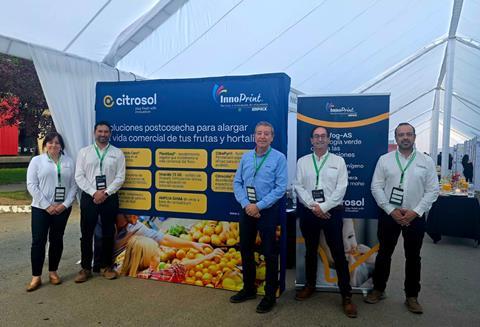
Citrosol and Innoprint took part as Gold Sponsors in the XXXIII National Congress of Phytopathology and the X Postharvest Symposium of Chile, held from 3-5 November at the University of Talca.
Innoprint is a Chilean packaging and labelling company that forms part of the Empack Group and serves as Citrosol’s strategic distributor and technical partner in Chile.
The gathering brought together researchers, academics, students, and professionals from the agri-food sector to share the latest advancements and address key challenges related to plant health and the preservation of fruit quality.
Organised by the Chilean Society of Phytopathology (SOCHIFIT) and the Faculty of Agricultural Sciences at the University of Talca, both events linked two closely related fields: crop protection against diseases and the preservation of product quality during the postharvest stage, storage, and transport to destination markets.
Decay control and resistance management take centre stage
Representing Citrosol were Juanjo Ferrandis, postharvest service executive, and Celia Murciano, R&D microbiology manager. Representing Innoprint were Andrés Vejares, head of postharvest, along with the company’s postharvest team. During the event, Murciano delivered a presentation titled ‘Postharvest Rot Control and the Problem of Fungicide Resistance’, in which she examined the development and spread of fungal diseases in storage facilities, as well as the factors that promote the emergence and selection of resistant strains.
Key factors highlighted included the accumulation of inoculum within the facilities, the use of suboptimal dosages, and shortcomings in the application of treatments or in cleaning and disinfection protocols.
The presentation also explored various tools for improving rot control and addressing the issue of resistance, including alternatives to conventional active ingredients that can complement standard treatments.
Among the solutions presented was Fortisol Ca Plus, a formulation that helps stimulate the fruit’s natural defences and is effective in controlling rot. Also introduced was Fung-Cid Gras SP, a potassium sorbate-based formulation designed to control rot, including resistant strains.
Another solution discussed was Greenfog-AS, a sorbic acid-based fumigant treatment that allows for rapid, uniform, dry application – eliminating the need for water and the generation of wastewater.
“This dual-action solution offers high disinfectant efficacy and can be used to treat produce within storage chambers and containers,” Citrosol said. “Greenfog-AS is highly effective against various fungi that cause rot and/or stem-end mould in fruits and vegetables, including Penicillium spp, Geotrichum spp, Cladosporium spp, Fusarium spp, Rhizopus spp, and Aspergillus spp.”
Greenfog-AS’s active ingredient is a “green chemistry” compound approved for the postharvest treatment of citrus; it is classified as a Gras (Generally Recognised As Safe) substance by the US FDA and as a “minimum-risk” fungicide by the US EPA.
Furthermore, the use of orthophenylphenol – a broad-spectrum active substance with a multi-site mode of action – was discussed. It represents a valuable option for controlling Penicillium (including strains resistant to other fungicides) as well as other pathogens such as Geotrichum.
Zero-Discharge System
The presentation also highlighted the contribution of the Zero-Discharge System within the Chilean citrus packing industry. Developed by Citrosol, this technology is designed to optimise postharvest treatments through consistent dosing, the maintenance of treatment solution hygiene, and continuous hydrodynamic filtration.
According to Citrosol, its implementation in numerous Chilean postharvest processing facilities has enabled better control over treatment solutions, contributing to more effective and uniform application while preventing the development of fungicide resistance.
“In conclusion, the presentation highlighted that the sustainable control of rot requires a comprehensive strategy combining properly applied treatments, a reduction in environmental inoculum, the cleaning and disinfection of facilities, and regular monitoring of Penicillium populations,” Citrosol said.