Company’s Sustainability Report for 2024/25 reports significant progress and highlights future challenges
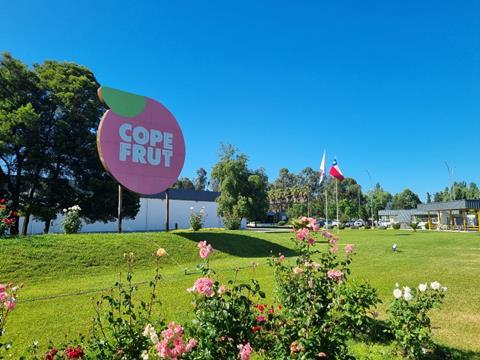
Copefrut has presented its 2025 Sustainability Report, providing a comprehensive overview of its production, commercial, environmental, and social operations during the 2024/25 season.
As well as presenting the company’s ESG indicators, the report sets out its future strategy around three major pillars – Planet, People, and Product – incorporating commitments and tracking goals for the 2025-2028 period. Sustainability is thus directly linked to aspects such as grower profitability, plant efficiency, market access, climate change, genetic innovation, and fruit quality.
In 2024/25, Copefrut worked with 171 growers, managing over 5,370ha of orchards, three processing plants, and four export fruit varieties: cherries, apples, kiwifruit, and plums. It exported a total of 90,240 tonnes of fruit to 359 clients in 47 countries
By market, Asia accounted for 46.56 per cent of exports, followed by Latin America on 31.61%, Europe on 17.76 per cent, the US and Canada on 3.39 per cent, the Middle East on 0.63 per cent, and Africa on 0.05 per cent.
This significant exposure to Asia is closely linked to the growing importance of cherries within the company’s product portfolio. Cherry exports grew 27.4 per cent to 36,618 tonnes, of which 35,142 tonnes were shipped to the Far East.
Plum exports increased by almost 36 per cent to 6,939 tonnes, driven primarily by demand from the Far East and Latin America. Kiwifruit volumes remained virtually stable, shifting from 10,213 tonnes to 10,199 tonnes, while apple volumes contracted by 2.5 per cent to 36,482 tonnes.
This data is significant as it reveals a gradual shift in Copefrut’s export mix, with cherries gaining importance within the business and Asia reinforcing its status as a key market.
New sustainability strategy for 2025–2028
The second major highlight of the report is the unveiling of the 2025-2028 sustainability strategy.
Copefrut has reorganised its approach to these matters around three pillars: Planet, People, and Product. These pillars incorporate commitments regarding energy efficiency, clean energy, water, packaging, biodiversity, working conditions, inclusion, communities, sustainable agriculture, producer profitability, quality, and commercial relationships.
Within the new framework, Copefruit links competitiveness and sustainability to production efficiency, varietal innovation, access to financing for producers, climate adaptation, and compliance with standards required by international markets.
The company has also updated its strategic planning with a ten-year outlook, envisioning an increase in productive acreage, partnerships with producers, improved efficiency, varietal innovation, expanded processing capacity, automation, and new commercial platforms.
Mixed picture for water progress
Copefruit has identified water management as a key area requiring close monitoring. It reports that the water reuse system implemented at the Linares Hydro-Bin facility reduced water consumption specifically associated with that process by 33 per cent. Furthermore, the percentage of fruit certified under the Spring standard rose from 38 per cent in 2023/24 to 46 per cent in 2024/25.
However, total water consumption across the company’s three plants increased from 255,043m³ to 279,792m³ between the two seasons. While Cenfrut reduced its consumption, Cenkiwi and Cenlinares recorded increases.
This presents a significant contrast: while there are efficiency improvements in specific processes, the challenge remains to translate these initiatives into a reduction or containment of the operation’s aggregate water consumption, Copefrut said.
Renewable electricity gains
The document also notes that renewable energy accounted for 86 per cent of the company’s operational energy use.
The company switched its electricity supplier to Colbún, enabling 100 per cent of the electricity purchased from the grid to come from renewable sources certified via I-REC. This figure should be distinguished from the 86 per cent renewable energy usage reported for the company’s operations as a whole, as the latter figure incorporates other energy sources.
This process is also extending to the growers. During the season, the company promoted the installation of solar panels at seven orchards using the ESCO model – a scheme that allows infrastructure to be installed without direct upfront investment from the farmer, with costs covered by the resulting energy savings. For a fruit-growing operation heavily reliant on precision irrigation, pumping, cold storage, and processing, the combination of energy efficiency and self-generation stands out as a key strategy the company said it aims to deepen in the coming years.
Challenges: suppliers, transport, packaging, and GlobalGAP
Copefrut also completed the quantification of its corporate carbon footprint for the third consecutive year and notes that it is moving toward ISO 14064 certification.
The data clearly identify where the challenges lie. Under Scope 1, combustion from mobile sources generated 871.71 tonnes of CO₂ equivalent; stationary sources accounted for 594.28 tonnes; and refrigerant gases for 15.01 tonnes.
By applying the market-based method and using I-REC certificates associated with purchased electricity, the report records zero tonnes for Scope 2 emissions from imported electricity.
However, the figures rise significantly in Scope 3: goods and services used account for 43,602.91 tonnes of CO₂e, while transport adds another 30,002.05 tonnes.
This is arguably one of the report’s most significant environmental findings: once direct energy sources are addressed, a large part of the decarbonisation challenge shifts to the value chain – specifically materials, suppliers, and international logistics.
The company also reported shipping its first zero-carbon-footprint atmosphere-controlled bags for cherries to China—a solution that is now being extended to kiwis and plums.
Packaging materials represent another area of focus. Copefrut reported a 5.3 per cent reduction in the amount of cardboard used per tonne of packed fruit compared to the previous season. Additionally, it renewed its agreement with CMPC to ensure that all boxes used carry FSC certification.
According to the report, this material reduction made it possible to fit an extra pallet per container and improve loading efficiency, directly linking an environmental measure to reduced logistical requirements. Such adjustments are becoming increasingly important for an export industry facing rising demands from retailers and markets regarding materials, recyclability, emissions, and environmental traceability.
Regarding orchard certifications, Copefrut reported 100 per cent GlobalGAP compliance across its four fruit varieties. Grasp coverage reached 96 per cent, while FSMA coverage reached 83% per cent of the total volume.
In addition, the implementation of the Leaf standard began in the 2024/25 season for kiwifruit and apple orchards. As part of this process, greenhouse gas emissions were quantified for the first time at the orchards adopting this standard.
In this initial stage, Leaf coverage reached 16 per cent of the combined kiwifruit and apple volume, with a penetration rate of 49 per cent for kiwifruit and 8 per cent for apples.
“From an agronomic perspective, these standards are particularly important because they begin to shift the focus of sustainability from the packing facility to the orchard, incorporating measurements related to water, emissions, biodiversity, soil, and resource management,” the company said.