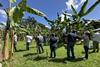
Corbana held an event to assess the agronomic performance and consumer acceptance of varieties from France and Brazil

The National Banana Corporation of Costa Rica (Corbana) held an event to present the results of its agronomic evaluation and organise tastings of several banana cultivars with resistance to Black Sigatoka and Fusarium TR4, two of the most aggressive diseases threatening banana production worldwide.

Corbana

Image: Corbana

The event, which was part of an ongoing process to analyse consumer acceptance and evaluate the possibility of producing these cultivars in the country commercially, included a field visit and a tasting for representatives of the banana industry.

These cultivars, evaluated by Corbana’s research department, were obtained through agreements with the French Agricultural Research Centre for International Development (Cirad) and the Brazilian Agricultural Research Corporation (Embrapa).

Costa Rica is a TR4-free country and remains vigilant, taking measures for its prevention and, if necessary, its eventual management.

“While it is true that Fusarium TR4 is not present in Costa Rica, we are working very hard to prevent its introduction; we must be prepared. This presents us with medium- and long-term challenges and will allow us to guarantee the continuity of the Costa Rican banana business around the world,” said Marcial Chaverri, general manager of Corbana.

Roy Arce Rojas, the corporation’s agrophysiology coordinator, added: “We present these to banana producers so they can learn about the cultivars and participate in the evaluation process, which has initially taken place in small experimental plots”. He said the goal is to build a database that will provide the industry with alternatives in the event of the arrival of Fusarium TR4.

After a brief introduction, the participants toured the Musa Garden at the research centre in La Rita, Pococí. There, they observed the cultivation, analysis, and preservation processes of the cultivars under evaluation, as well as the other materials that make up this Musa bank. These include other varieties that are not currently commercially available but are part of the ongoing scientific research conducted by Investigaciones-Corbana.

Subsequently, a tasting of six varieties from Embrapa and Cirad was conducted to analyse their quality and gauge the overall acceptance of the fruit.

“This is a way to verify if these cultivars are promising and if they are well-received by consumers. The feedback on their texture, flavour, and aroma is very important because it provides us with a frame of reference for the possibility of developing them in the future,” said Rafael Segura, director of research at Corbana.

According to Corbana, introducing these materials is a meticulous and elaborate process. The plants arrive from their origin (in this case Brazil or France) under strict phytosanitary conditions and undergo a quarantine and adaptation process before being transferred to the experimental areas for agronomic evaluation. This ensures the phytosanitary safety of the cultivars prior to evaluation under the country’s specific ecological production conditions.

“With this effort, Corbana is advancing a scientific and technical strategy aimed at strengthening the resilience of the banana sector and ensuring the continuity of supply to international markets,” the corporation said.