Jorge Pelaez of Fresh Del Monte Produce discusses declining banana source volumes, varietal development, and greater support for growers

In July 2025, Fresh Del Monte Produce chairman and CEO Mohammad Abu-Ghazaleh used the company’s second quarter earnings call to issue a stark warning of an oncoming banana crisis, driven by the spread of diseases such as Black Sigatoka and TR4 and the resulting imbalance between global supply and demand. Come October, and Fresh Del Monte’s third quarter call, Abu-Ghazaleh again commented on the mounting pressure.
“Sustaining this category over the long term will require closer alignment across the value chain, ensuring that pressures in the fields are understood – and shared – throughout the supply chain. The farmer can no longer absorb these rising costs,” he said. “It’s easy to take the banana for granted – simple, familiar, always there. But behind that simplicity lies one of agriculture’s most coordinated and collaborative supply chains.
“Protecting it is our shared responsibility – and if we don’t act collectively to support growers and stabilise this supply chain, we risk seeing this fruit – and the livelihoods behind it – disappear before our eyes,” he warned. “That reality weighs heavily on me and drives much of our focus today.”
Here, Fresh Del Monte’s senior vice-president for Colombia, Brazil, Ecuador and Central America, Jorge Pelaez, delves into the current state of the business, addressing challenges raised by Abu-Ghazaleh and explaining what the company is doing to secure the long-term future of the banana industry.
Hello Jorge. Can you tell us about your role at Fresh Del Monte Produce, and the operations that you oversee?
Jorge Pelaez: As senior vice president for Colombia, Ecuador, Central America, and Brazil, I lead a workforce of over 23,000 across multiple countries, ensuring market alignment through timely delivery of the right quantities of fruit with the required quality and cost efficiency.
I oversee resource management across farms, port operations, and related facilities, driving operational excellence and strategic alignment to achieve company objectives.
I also maintain strong relationships with growers and Fresh Del Monte Produce’s other strategic partners in order to support long-term business success.
Fresh Del Monte chairman and CEO Mohammad Abu-Ghazaleh has repeatedly warned the business about a global shortage in banana production. What is driving this imbalance between supply and demand?
JP: The imbalance is mainly caused by a decline in source volumes, driven by climate change and the impact of diseases – some of which are directly linked to changing weather conditions. As a result, the available resources are insufficient to meet even previous demand levels, leaving no capacity to accommodate additional demand year after year.
When it comes to supply, Ecuador produces approximately 285mn 40lb boxes of bananas for export, making it the largest producer in Latin America – far surpassing the combined output of Costa Rica and Guatemala. For Fresh Del Monte, Ecuador represents a relatively small production area. However, it is extremely important because it supplies fruit during periods when Central America cannot, due to adverse weather conditions. This makes Ecuador a critical region for ensuring a consistent and reliable supply of bananas to our customers.
What is being done to address these concerns, particularly on the disease front?
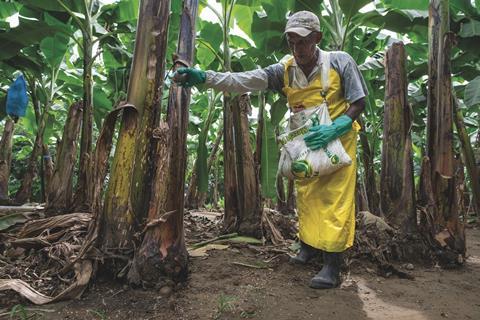
JP: Timely and well-executed biosecurity practices are essential to keeping disease incidence low and extending the period during which the situation remains manageable. Unfortunately, visible symptoms of TR4 may not appear until some period after the fungus has already established itself in the soil. If preventive measures are not in place before symptoms emerge, they are likely to be ineffective and eventually overwhelmed due to the movement of people, tools, planting materials, and even flooding during the fungus’ latency period.
If the infestation worsens and truly resistant banana varieties are not available, the only viable option for continued production may be the use of tolerant cultivars within annual or semi-annual production cycles that require more frequent crop renewals. While this strategy may help sustain production, it will inevitably lead to increased costs and could result in fluctuations in banana supply over the short to medium term.
Fresh Del Monte has formed partnerships with institutions to develop varieties that can be cultivated even in the presence of TR4 and is currently in field trial phases with some of them to understand their growth characteristics and productive aspects. This phase is essential because a tolerant/resistant variety must also maintain the characteristics required for customer acceptance while ensuring adequate productivity to make it economically sustainable.
How is supply shifting across the business as a result of the current pressures?
JP: At Fresh Del Monte, we are actively preparing for the future by partnering with organisations that develop agricultural technologies, and by adapting our farming practices based on evaluations conducted by our own multidisciplinary research departments. Additionally, having production operations spread across multiple countries and continents allows us to mitigate the impact of climate change and plant diseases in any single location. This geographic diversification helps us manage risk and maintain a consistent supply of fruit to our customers.
Looking ahead, it’s clear that only companies investing in their farming operations – particularly in research, development, and technology – will be able to sustain adequate production volumes and meet market demands reliably over time.
It is becoming harder for farmers to absorb rising supply chain costs. How can this be rebalanced to ensure the future of the industry?
JP: For the long-term viability of the business, we are providing producers with opportunities to place all their fruit – minimising the excess that would otherwise have to be sold at a lower price in the market or lost – through agricultural techniques to advance or delay production so that volumes align with market demand. This gives them an economic benefit that can offset not only increased costs but also provide the funds to invest in varieties or technology necessary to keep their business in good condition. Our experimental department is very robust, covering all areas of crop production and offering technical assistance across many areas, serving as a preventive method to avoid major problems with diseases and changes in crop growth conditions.
Do you think there is enough education about the complexity of the banana supply chain?
JP: With the TR4 disease threat, more people are becoming aware of how quickly the banana supply chain can change. Organisations like the Banana Association of North America (Bana) are an example of how the conversation is turning to consumers, informing them about the climate and disease pressures that are impacting the banana industry and, in turn, affecting their grocery hauls.
In our case, since we have operations in areas of Asia where the disease has been present for years, we have expertise in how to manage it. We have even given presentations at some grower associations highlighting the difference between a farm with preventive measures and one without them. The presentation of photos comparing well-maintained areas to those that aren’t is very helpful for producers.
To support and educate, our highly skilled research department plays a critical role in supporting both current and potential growers. We provide them with data-driven programmes that enable precise harvest planning – advancing or delaying harvests to avoid overproduction and minimising waste. Additionally, we offer solutions to maximise fruit utilisation, including packing smaller or non-standard bananas (such as single fingers or fruit with lower calibration) to meet diverse global market demands. This approach ensures that growers working with us can monetise their entire yield, enhancing sustainability and grower profitability.
What role do you anticipate developing and emerging technologies will play in the future of the banana business?
JP: Emerging technologies like TR4-resistant banana varieties will provide the opportunity to grow bananas with adequate productivity, which will not only supply the required volumes to the markets but also ensure a level of productivity that keeps costs within what customers can afford.
For Fresh Del Monte, having these varieties tested – especially in agronomic and productive aspects – gives us the opportunity to select not only those most suitable in terms of resistance/tolerance to the disease but also to consider cost and permanent supply to the markets from the outset.
Are you confident that Fresh Del Monte is well-placed to tackle the challenges ahead?
JP: We are a company that maintains its research department with experts in all areas, and this investment makes the difference in critical moments of crop impact while also providing the opportunity to develop and evaluate new techniques. This is something that has disappeared in most companies that have cut costs to achieve better short-term results, but at the expense of reducing the ability to generate better outcomes in the future.
The ongoing review by experts in all areas of the crop is a guarantee of being able to act preventively, rather than only when the problem has already appeared – when stopping it can be more expensive or even too late.