Crop estimates signal a further contraction in European pear production, with Belgium, France and Spain all forecast to see year-on-year declines
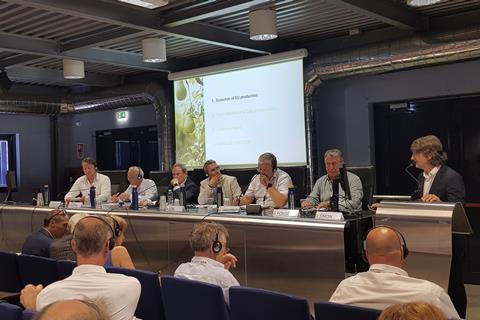
This year’s Interpera congress revealed a mixed set of initial forecasts for Europe’s leading pear growers.
More than 200 producers and experts gathered in Ferrara, Italy, for the event, where European crop estimates pointed to a slight decline for most countries.
In Belgium, production is forecast at around 363,875 tonnes, with a year-on-year fall of 7 per cent, while French production is estimated at around 143,000 tonnes, down 6 per cent.
Spanish pear production is expected to come in at 251,265 tonnes, representing a drop of 6 per cent.
Portugal, by contrast, is expecting a larger crop, up 13 per cent on 2025 to 130,500 tonnes.
In the Netherlands, production will be on a par with, or slightly higher than, the last campaign.
Italian production ”currently appears to be higher than last year’s”, but Interpera stated that as the situation varies considerably from one region to another, the estimates are not yet final.
At the event, Elisa Macchi, director of CSO Italy, highlighted the decline in production across the EU.
She pointed out that, ten years ago, European production potential stood at around 2.4mn tonnes.
However, by 2025 production had stabilised at around 1.8mn tonnes, due to a reduction in cultivated areas and difficulties linked to climate, plant diseases and the increasing complexity of management.
Developments in recent years have also revealed a shift in the balance of power among producing countries.
Until 2018, Italy played a ”very significant” role on the European stage; after 2018, the geography of production diversified, with Belgium and the Netherlands gaining ground, Macchi continued.
Italian production in 2025 stood at around 293,000 tonnes, down by approximately 27 per cent on the previous year and a far cry from historical levels, when the national average exceeded 700,000 tonnes.
On the trade front, she emphasised that, despite the decline in supply, exports to Europe had fallen only moderately.
Macchi also highlighted the growing international focus of certain countries, as well as the differences in their ability to establish a presence in foreign markets.
The volume of product heading for export varies widely among the leading producers, with the Netherlands sending 86 per cent of the crop to overseas markets, Belgium 85 per cent, Poland 97 per cent, Portugal 58 per cent and Spain 38 per cent.
Italy’s export share stands at just 14 per cent, largely due to the greater importance of its domestic market.
Presentations throughout the conference highlighted the challenges facing the sector in the six main EU-producing countries, including generational renewal, crisis management, plant protection, adapting the production system to climate change, orchard productivity and labour costs.
Key takeaways from the speakers involved at Interpera included the need to boost consumption by reaching new consumers (particularly young people), whilst advocating for its inclusion in public health policies; the importance of research and innovation for the development of new varieties, in particular, better suited to the effects of climate change; the need for active ingredients to protect orchards; and the importance of the Common Agricultural Policy, and in particular the Common Market Organisation for fruit and vegetables and the operational programmes.