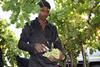
Shipments to Europe get under way around a month later than usual, with lower yields driving up prices, according to leading exporter
India’s table grape industry has begun loading shipments for Europe in the past two weeks, much later than usual due to rain-affected growing season.

Azhar Tambuwala, director of major producer organisation and exporter Sahyadri Farms, told Fruitnet that while some shipments from Nashik were going to the Middle East and Russia during December/January, the first exports to Europe only commenced in late January.
“The export season [to Europe] has been delayed by around four weeks as we usually start in Week 1 or 2,” he said.
Tambuwala said the late start was favourable from an EU market perspective, however, as the South African season, which precedes India’s, has also been delayed. “It means there won’t be a gap in supply as South Africa will cover the window before Indian fruit arrives.”
The key challenge to the Indian export campaign is limited availability of early season fruit, which has driven up prices, he explained.
“Early season fruit is more than double the cost of normal levels,” he told Fruitnet. “We need three of our farmers to fill a container rather than two because the yields are much lower this year. Exporters must reach out to more farmers, which drives up prices. The question is, will those prices be sustainable?”
“European markets will pay higher prices for long-transit fruit from Peru or Chile, but from India they generally expect lower sales prices of around €9-10 per carton (US$10.64-11.83). With the elevated cost prices, we need the market to be consistently paying sales prices of €13.75-14 per carton FOT (free on truck) this year to keep it sustainable. Will the market pay that?”
Prolonged and heavy rainfall across India’s key table grape production area of Nashik during the growing season has heavily disrupted the 2005/26 campaign. “The weather is warming up now, but we had almost six months of rain, which messed up a lot of things, and a lot of pruning got delayed,” Tambuwala explained.
Yields are down substantially on key varieties, with Sahyadri’s latest survey of farmers indicating that average yields on Thompson Seedless are only 50 per cent of normal levels. “Some blocks are producing as little as 10 per cent of a normal yield,” he noted.
On a brighter note, he said new varieties from proprietary breeding programmes had performed much better in the rainy conditions. “New varieties like Cherry Crunch, Fire Crunch and Allison withstood the rains well. We have good volumes of those red varieties as production is maturing,” he said. “We’ll have enough fruit for our customers, but it means there will be a mix of white and red grapes. We’ll likely ship the same volume overall, but the ratio of red to white will be higher.
Tambuwala said the rains had demonstrated to farmers the benefits of the new varieties. “Farmers who have adapted to the new varieties are happier and they’re seeing the benefits of switching over,” he noted. “They cannot afford not to have a crop.”