Cacta says its sustainability management platform is evolving from static reporting to dynamic scenario analysis and future impact modelling
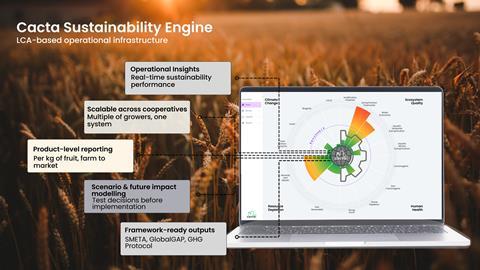
Sustainability reporting has traditionally been a time-consuming and complex task, relying on spreadsheets, audits, and multiple frameworks. Now, agtech startup Cacta has created a sustainability management platform that positions data as a structured, operational tool, helping producers cooperatives and consolidators manage environmental impact across their supply chains rather than treating it solely as a compliance requirement.
Juan Pablo Tena, partner and head of business development at Cacta, says the box-ticking approach to sustainability compliance is no longer fit for purpose. “We no longer position Cacta as a reporting tool,” he tells Fruitnet. “We see it as a technical sustainability infrastructure for agro-export supply chains.”
That shift in mindset reflects how the company’s LCA-based sustainability management software has evolved. Built on Life Cycle Assessment methodology (ISO 14040-44), Cacta uses automated data capture to calculate 16 environmental impact indicators across climate change, ecosystems, human health and resource depletion. According to Tena, what began as a way of simplifying compliance has become something much more ambitious: a system designed to make sustainability data automated, repeatable and comparable across markets: LCA is shifting from static reporting to dynamic scenario analysis and future impact modelling.
Cacta already creates sustainability passports and LCA-based reports for individual crops and farms. But recent developments go well beyond this. “Water and carbon, for example, are no longer treated as marketing claims, but as operational performance variables,” Tena explains. “Packaging is analysed as a logistics and footprint driver, not just a declaration field. And Scope 3 emissions are addressed from upstream, real operational data rather than broad estimations.”
New modules on Cacta’s roadmap include automated report outputs for frameworks such as Smeta, GlobalGAP and GHG Protocol; benchmarking tools for cooperatives and consolidators; real-time campaign monitoring via ERP/API integrations; and predictive modelling that allows producers to simulate how changes in inputs will affect environmental outcomes.
Despite growing pressure from retailers, governments and financial institutions, sustainability reporting remains painfully inefficient for many producers. Tena believes the core problem is not resistance, but data.
The real bottleneck, he says, is the lack of digitalised data capture. Most producers are still working with manual spreadsheets, dispersed files and non-standardised formats. The same data gets requested again and again, but in different formats. Audit fatigue is becoming a serious concern across the industry.
“Farmers are often asked to provide the same evidence multiple times for carbon, water and social compliance,” he says. “It’s inefficient and unsustainable.”
The answer, in his view, lies in improving interoperability and introducing a global minimum sustainability data baseline at farm level. Reporting, he argues, should follow the way products are commercialised, using functional units such as kilograms of fruit rather than abstract company-level averages.
“This is exactly where we add value,” Tena says. “We enable producers to report sustainability metrics per product. That reduces audit fatigue and delivers a clear, comparable view of impact from farm to market.”
Looking ahead, Cacta’s growth strategy is focused on two areas. The first is to target export-oriented producers in regions such as Egypt, South Africa, Argentina, Colombia, Ecuador and Costa Rica. Here, Cacta acts as a solution partner, helping producers meet European market requirements while navigating the realities of operating in developing economies.
The second focuses on European cooperatives and consolidators managing hundreds of growers with varying levels of digital maturity. “We help them centralise and harmonise operations so they can function like a single enterprise,” Tena explains.
Ultimately, Cacta’s ambition is for its solution to deliver measurable ROI rather than another compliance checkbox. “Automating data flows and aligning reporting formats will reduce friction while laying the groundwork for long-term efficiency gains,” Tena says.
“By turning sustainability data into a shared, operational backbone rather than a reporting headache, Cacta is positioning itself not just as a compliance tool, but as a catalyst for smarter, more resilient fresh produce supply chains.”