Funds will be used to develop a high-volume spectral imaging solution for automated quality control of fresh produce

OneThird

Image: OneThird

Dutch agtech startup OneThird has been awarded an innovation credit of €1mn from Netherlands Enterprise Agency RVO. The company will use the funds to develop a high-volume version of its non-destructive quality assessment tool – a spectral imaging solution that allows full trays and crates to be scanned in just a few seconds during the quality control process.

The new technology will be used to measure parameters such as Brix, sugar content, and visual defects and predict the shelf-life of the batch. It is expected to be available in 2027 for strawberries and blueberries, with expansion to other fruits and vegetables in the future.

Traditional QC methods are time-consuming and largely based on manual sampling, where only a limited number of units per batch are checked. This can lead to unreliable quality assessments and unnecessary waste. “We have already demonstrated with our current spectral scanner that non-destructive measurement at fruit level delivers a proven improvement for growers, distributors and retailers,” Marco Snikkers, commercial & product strategy and founder of OneThird says.

“We see a great need in the market for quality control on scale. With support from the innovation credit, we can now deliver a solution to this problem. While our current scanner is already a big improvement over traditional methods, spectral imaging is the next step.

“By scanning not one but many products simultaneously, we make it possible to go from sampling to full inspection. In an inline application, that means only the punnets that fail to meet specifications are rejected, not the entire load. We look forward to bringing this technology to market and helping to reduce food waste.”

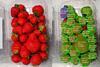
In three seconds, the solution can scan a full crate with ten punnets, without manual interaction, enabling a shift from sampling to representative batch inspection and making quality insights per shipment significantly more reliable.

According to the company, the solution offers significant waste reduction and labour-saving benefits. It said customer interviews and simulations show that imaging can reduce waste by an average of 20 per cent per batch.

And, says the company, one of the most powerful applications of the new technology is the improvement of shelf-life prediction. “Where strawberries traditionally receive a fixed best-before date based on an average (for example, a standard five days after picking), OneThird knows that actual shelf-life varies considerably, from three to 13 days,” the company explains.

“The spectral imaging solution makes it possible to accurately determine, per punnet, how many days the fruit will remain fresh. Growers can therefore fine-tune their machine settings considerably, supermarkets no longer need to remove punnets from shelves prematurely, and waste throughout the supply chain is significantly reduced.

“Moreover, this solution makes quality control fully objective, reproducible and traceable. Growers and distributors can use this to make better-substantiated agreements with their buyers about the quality of delivered fruit. This strengthens the negotiating position with retailers and exporters and increases the acceptance rate of shipments.”