Drewry’s Global Index rises as fuel costs and geopolitical tensions bite
The global ocean freight market is showing signs of renewed volatility as shippers battle to deal with the fallout from the Iran war. According to the latest World Container Index (WCI) report published by consultancy Drewry, the composite index rose 1 per cent last week to US$2,309 per 40-foot equivalent unit (FEU).
While the overall increase appears moderate, the underlying dynamics reveal growing pressure on international supply chains, driven by instability in the Strait of Hormuz and rising fuel costs. Drewry said it expects spot rates to continue rising in the near term as shipping lines struggle to cover the increasing operating costs stemming from the crisis in the Strait of Hormuz.
Rate behaviour varied by region, with a notable upward trend in the Atlantic and Pacific compared to a correction on routes to Europe:
The Transatlantic Route (Rotterdam – New York) saw the sharpest movement, jumping 25 per cent to US$1,968 per FEU. Drewry said the increase was due to a 13 per cent contraction in available capacity for April. Rates from Shanghai to New York and Los Angeles rose by 7 per cent and 9 per cent respectively, reflecting strong demand and the pass-through of operating costs.
By contrast, rates from Shanghai to Rotterdam and Genoa fell between 3 per cent and 9 per cent, due to more stable capacity on this specific route.
According to Drewry, the availability of bunker fuel is a critical challenge for the sector. The conflict in the Middle East has limited supply in key hubs like Singapore and China, driving up prices.
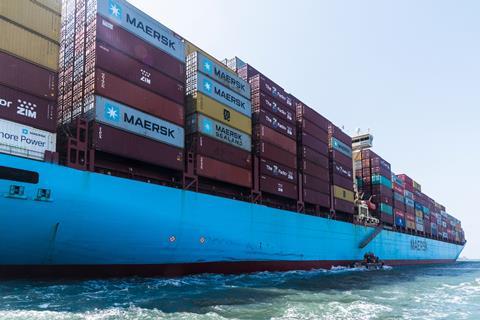
In response, major shipping lines like Maersk have already applied for authorisation to implement emergency fuel surcharges immediately, eliminating the usual 30-day notification period. These surcharges could range from US$100 to US$200 per TEU.
Drewry warned that the combination of slow steaming to conserve fuel and the implementation of these surcharges will keep freight rates high in the coming weeks. Although analysts suggest the situation will not reach the crisis levels seen during the pandemic, geopolitical uncertainty remains the primary driver of inflation in the shipping industry.