Fruit Logistica panel covered challenges facing the business and how greater resiliency and efficiency in logistics can be achieved
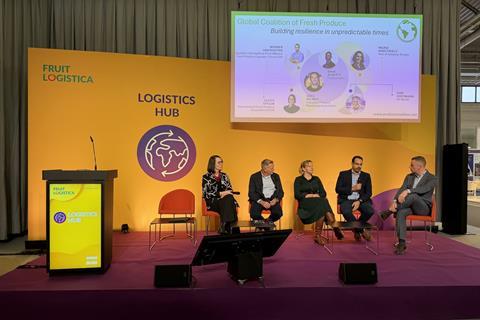
At Fruit Logistica in Berlin, the Global Coalition of Fresh Produce hosted a Logistics Hub session focusing on the systemic volatility the fresh produce industry is facing, and exploring how stresses affect shipping rates, capacity, reliability, and the integrity of perishable cargo.
Moderated by Steve Alaerts of Foodcareplus, and chair of the Supply Chain Council at the International Fresh Produce Association (IFPA), the conversation covered the challenges being faced – shifting trade flows, geopolitical shocks, and unpredictable regulatory environments – what a resilient model for fresh produce logistics looks like, and what can be done to make the vision a reality.
Speaker viewpoints
Greg Palmer, vice president, trade and market development at the Canadian Produce Marketing Association and chair of the Global Coalition of Fresh Produce, highlighted three common supply chain disruptors: increasing transit delays, volatile import tariff structures, and rising cybercrime.
According to Palmer, what matters most to shippers globally today is digital traceability and transparency; in addition, there is an urgent need to improve both capacity and speed in shipping lanes worldwide.
Werner van Rooyen, COO of the Fresh Produce Exporters’ Forum of South Africa and leader of the Working Group on Logistics of the Southern Hemisphere Fruit Alliance, called for more transparency and predictability in dealings between all actors in the logistics chain.
Van Rooyen said that clear and stable pricing, contract terms, and service conditions are a prerequisite for sustainable, resilient supply chains.
Another key element he proposed is the prioritisation of fresh produce.
Fruits and vegetables are highly perishable products and should be given priority over non-perishable items in shipping, handling, and port transit and customs clearance procedures, van Rooyen noted.
Port connectors and climate change
Tineke van de Voorde, key account manager shippers and forwarders at the Port of Antwerp–Bruges, shifted the focus to the crucial role of port authorities as ’connectors’ between operators in the supply chain.
Van de Voorde’s key message was a call to action: cooperation across the chain can help resolve major challenges.
Port congestion, for one, requires port authorities to a play a key facilitating role in the flow of information between operators, she said.
Dirk Hoffmann, commercial director at DP World Atlas, issued a stark warning to the audience that climate change is not something that will happen some day – it is already happening.
The fresh produce industry must urgently develop innovative solutions to reduce its logistics footprint, he noted, offering a concrete example in the shape of the newly launched DP World Atlas service, which connects Morocco with Belgium and the UK.
Alexis Taylor, chief global policy officer at the IFPA, closed the loop by bringing in industry organisations.
In Taylor’s view, these groups can help turn the vision of resilient logistics chains into reality by developing and promoting common good practices – standards, instruments, and behaviours that promote transparency, efficiency, and fairness throughout the supply chain.
A prime example, she said, is IFPA’s Supply Chain of the Future, offering functional solutions aimed at ensuring that fresh produce moves seamlessly from farm to table.
How do we go from here?
Alaerts tied the discussion back to the opening question: what concrete actions can we take to make the vision of resilient and efficient supply chains a reality?
A key element that resonated throughout all interventions was the need for a foundational framework – a fundamental, structural set of shared values, principles, or guidelines to underpin, guide and support behaviour and processes throughout logistics chains.
Upholding the central principles of collaboration, transparency, and fairness, this foundational framework would break down silos, offer a common understanding and language, and align actions with the shared goal of efficient and resilient global logistics chains that bring high-quality fresh produce from the grower to the consumer, with less waste and fair rewards for everyone.
Alaert’s closing remark was an invitation to all those involved in fresh produce logistics to come together and jointly formulate a foundational set of values to anchor and transform global supply chains.


