At Fruit Logistica, the WAO highlighted ten years of data-led growth that has helped turn the fruit into a mainstream food across Europe
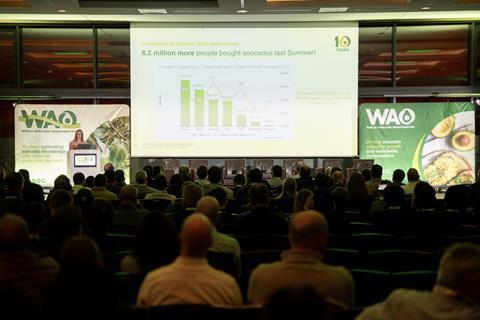
The World Avocado Organisation (WAO) celebrated its tenth anniversary at Fruit Logistica in Berlin by hosting its annual industry event ahead of the trade fair, welcoming professionals from across the global avocado sector.
Held on the eve of Fruit Logistica, the event brought together stakeholders from throughout the value chain and served as a platform to share a comprehensive overview of the European avocado market, combining retail performance results, consumer insights and strategic perspectives on how the category continues to evolve across key European markets.
During the event, WAO also welcomed a presentation by Eric Imbert, researcher at Cirad, who shared independent supply and consumption insights from across the global avocado market, providing additional context on long-term consumption trends in Europe.
The insights presented confirmed that 2025 was a ”very strong year” for avocados across Europe, reflecting the impact of a decade of sustained, data-driven market development.
“As we mark ten years of the World Avocado Organisation, it’s striking to see how quickly the avocado sector has evolved,” said Shelly Vorster, recently appointed managing director of the WAO.
“Over the past decade, avocados have moved from being a niche product to a mainstream food across many European markets.
”WAO’s role has been to support that evolution by helping the industry better understand consumers, grow household consumption, and frequency of purchase, and helping the industry anticipate emerging trends to drive sustainable category development,” she explained.

Strong increase across Europe in 2025
Research presented by Cirad showed that average avocado consumption across the EU27+ reached 1.8kg per capita in 2025, marking the strongest annual increase of the past decade and confirming a sustained upward trend over the last ten years.
Avocado volumes across Europe grew by an average of 16 per cent in 2025, underlining the category’s continued momentum across both established and developing markets.
Country-level analysis showed consistent growth across Europe, driven by a combination of higher purchase frequency, expanding household penetration and the growing relevance of avocados in everyday consumption.
Growth in 2025 was also driven by a significant expansion of the consumer base, the research showed.
During Summer 2025, 6.2mn more people across Europe bought avocados, “highlighting the category’s continued ability to attract new consumers and expand beyond its traditional audience”.
German growth, French leadership
Germany emerged as the fastest-growing avocado market by volume in Europe, recording 32 per cent year-on-year growth.
Despite this rapid expansion, avocados are currently purchased by only 44 per cent of German households, highlighting the market’s significant untapped potential.
Germany’s performance positions it as a key driver of future growth, combining strong current results with clear opportunities to recruit new consumers.
Italy was the second-fastest growing avocado market in Europe, with volumes increasing by 26 per cent, well above the European average.
Growth in Italy is largely driven by new shoppers entering the category, as avocado consumption continues to expand beyond early adopters.
In Central and Eastern Europe, Poland stood out as the third-fastest growing market, recording 27 per cent volume growth.
With 50 per cent of households already purchasing avocados, further growth is expected to come from both increased purchase frequency and the continued recruitment of new consumers.
The Netherlands remains a developing market, Cirad data pointed out, with 46 per cent of households purchasing avocados in a single year, while avocado value share stood at 6.4 per cent, well below the European average of 16 per cent, indicating further room for growth.
Romania also showed positive momentum, with 13 per cent volume growth and 47 per cent household reach, confirming its status as a developing market with ongoing potential.
France continues to be the largest avocado market in Europe by volume.
In 2025, French avocado sales increased by 16 per cent, resulting in substantial volume gains.
Most of this growth was driven by existing shoppers buying avocados more frequently and in greater quantities, confirming the category’s strong integration into regular household purchasing habits.
Different stages of development
The data highlighted the different stages of market maturity across Europe.
In Spain, growth was driven primarily by existing shoppers buying avocados more often, with opportunities identified beyond major urban centres and among retailers that currently under-index in avocado sales.
According to the latest research, the Spanish retail avocado sector grew by 9 per cent in volume last year.
Value growth reached 20 per cent, predominantly driven by increased purchase frequency among existing shoppers, as well as higher average prices.
The UK also continues to be a developing market, Cirad confirmed.
While British shoppers already purchase more avocados than consumers in most other European countries, growth potential remains strongly linked to the recruitment of new consumers, encouraging first-time purchases alongside continued increases in volume among existing buyers.
Portugal, while still an emerging market with 32 per cent household penetration, recorded a slight 1 per cent decline in volume, underlining the varying dynamics across European markets.
Evolving consumption
Beyond retail performance, independent market analysis presented during Fruit Logistica also provided a broader context on how avocado consumption continues to evolve across Europe.
The analysis showed that avocado consumption has now become firmly established across Western Europe, with around 60 per cent of European consumers living in countries where per capita consumption exceeds 2kg.
At the same time, significant growth potential remains in developing markets, particularly in Italy and parts of Eastern Europe, where per capita consumption is still well below the European average.
Germany, Italy and Eastern Europe have been identified as the main drivers of current growth, together accounting for a substantial share of the increase in European consumption.
These markets are playing a central role in shaping the next phase of avocado development in Europe, as the category continues to expand beyond early adopters and into more mainstream consumption.
“As the avocado category enters a more mature phase, the focus is no longer just on growth, but on growing responsibly.” explained WAO chairman Zac Bard.
”European markets are increasingly diverse, with different cultural and consumption dynamics, and this requires tailored, locally relevant strategies.
”Our priority is to continue supporting demand-led growth, while working with our members to ensure a resilient and sustainable supply for the years ahead,” he added.


