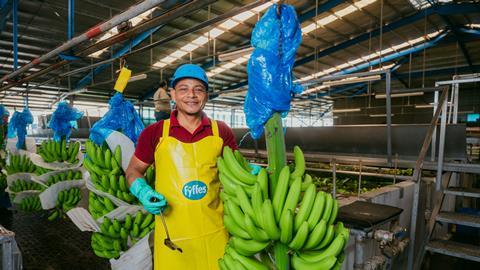
Caoimhe Buckley, chief corporate affairs officer at Fyffes, tells Fred Searle about the key trends, challenges and opportunities shaping the global banana industry
What are the main trends, challenges and opportunities in the banana sector at the moment?
Trends
The trend for healthy eating continues and with the start of the year, we see an uptick in banana consumption as people kick start their New Year’s resolutions with smoothies and gym-friendly snacks.
Sustainable and responsible sourcing remains a priority for retailers and consumers alike, with an expectation that fresh produce suppliers are not only transparent regarding their responsible supply chain practices but also have ambitious targets to improve social and environmental performance.
Our extensive consumer insights tell us that there is a large underserved market – consumers that are brand label enthusiasts and environmentally conscious. Fyffes has responded by reinvigorating its Fyffes blue label in Ireland and the UK, as well as offering its community-impact Trudi’s brand, which has been taken up in the UK and Norway.
Governments in supplier and consumer markets are increasingly focusing on eliminating the living wage gap by raising the minimum wage, with Colombia the latest country to announce a significant increase in minimum wages.
Challenges
One of the biggest issues facing the fresh produce sector is climate change. Winter storms and port congestion are affecting supply to shop shelves in winter, as well as raising costs.
We are dealing with this through a multi-sourcing strategy that we have developed over many years, as well as climate mitigation efforts on our own farms and with our suppliers.
We are extending our regenerative agriculture practices and implementing biodiversity targets, as well as our planned commitment to net zero. We already have a Science Based Target initiative (SBTi) endorsed greenhouse gas reduction target for Scope 1, 2 and 3 emissions.
Opportunities
Retailers with strong sustainability commitments are increasingly moving away from the annual tender cycle, looking to form long-term partnerships with suppliers and investing in community and environmental projects with them. Supermarkets are embracing the shared value concept and are willing to invest in projects that benefit people and planet, including living wages.
Despite the complaints about the EU’s Corporate Sustainability Reporting Directive, at Fyffes we believe this process has given us a great opportunity to further align our company strategy to our double materiality process, as well as environmental, social and governance priorities.
How much scope do you see for a shift towards more sustainable banana pricing following the early success of the Trudi’s brand in the UK and Norway?
Very low. While we welcome the early success of the Trudi’s brand in the UK and Norway as a positive step, we are not currently seeing a broader shift towards more sustainable banana pricing in the market.
The Fairtrade reference price announced ahead of Fruit Attraction 2025 has contributed to more realistic pricing dynamics, helping support sustainable returns for growers where Fairtrade programmes are in place. However, this has not yet translated into a sustained, sector-wide move towards higher or more sustainable banana prices across the category.
At this stage, pricing for bananas remains largely driven by conventional market forces and competitive retail dynamics, and we are not seeing consistent upward movement in pricing that would reflect more widespread, structural adoption of sustainable cost recovery across the supply chain.
What work are you doing to improve support for human rights and embed responsible business practices in your global operations?
Human rights and responsible business practices are one of Fyffes’ strengths. We have evaluated all our suppliers against our new supplier onboarding and due diligence framework, and we require our suppliers to complete a human rights and environmental impact self-assessment tool. We have also included a number of our suppliers in independent on-site human rights impact assessments, working with independent experts.
All our suppliers are required to sign our Supplier Code of Conduct and our Due Diligence Policy. Every year, we publish a Human Rights Report where we transparently disclose our issues, mitigation and prevention plans.
Following the recent arrival of TR4 in Ecuador, how is the fungal disease affecting UK/international banana supply at the moment?
We remain vigilant regarding TR4. We helped develop the GlobalGAP TR4 add-on several years ago; we are members of the Global Alliance Against TR4; and we have stringent biosecurity measures in place on our own farms as well as supporting suppliers with biosecurity measures to contain the disease.
The disease is not impacting global supply in any major way; we are more concerned with climate related impacts, including the prevalence of Sigatoka, which thrives in excessively humid conditions.
What have been the main supply challenges in bananas in recent months? How have growing conditions been in key source countries?
In recent months, banana supply has been affected mainly by increasing climate volatility in key producing regions. Periods of heavy rainfall, storms and heat stress in parts of Central and South America have made growing conditions less predictable, impacting yields and adding pressure on farms.
These challenges have been compounded by higher plant health and disease risks and some operational and logistical disruption in certain origins. Overall, growing conditions have been mixed rather than consistently poor, but more challenging than in previous years.
How are automation and AI changing the way banana supply chains operate?
We predict that fresh produce harvesting will remain a primarily human-based activity due to the delicate nature of the produce.
In banana supply chains, ag-tech, automation and AI are increasingly being used as practical enablers across agriculture and operations. They are not a strategy per se; they are enablers to solve current challenges.
On farm and in packhouses, technologies such as automated sizing and grading systems apply computer vision to improve consistency, reduce waste and support labour efficiency.
More broadly, AI is being used to strengthen prediction and forecasting, helping anticipate weather events, crop performance, demand patterns and logistics risks so banana supply chains can plan earlier, respond faster and operate with greater resilience in an increasingly volatile environment. The applications are broad and will help us achieve the next efficient frontier.
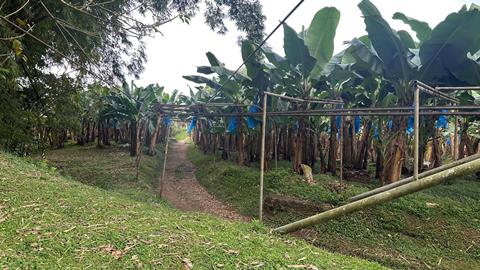
Resilience through diversification
SHP Group reports that countries such as Colombia, Guatemala, the Dominican Republic and parts of West Africa are investing in expanded banana plantings. Matthew Pudney, business unit director of SHP Bananas, drivers include diversification away from Ecuador (amid security issues), access to key markets, relative political stability, and opportunities to supply certified or premium segments. Some producers are also investing in new plantings to replace ageing farms with more productive and disease-managed systems.
Pudney adds that the banana sector is facing a combination of rising costs, structural risks, and shifting market expectations. Key challenges include higher input costs (fertiliser, freight, labour), climate volatility, disease pressure (notably TR4), and political instability in certain producing regions.
He believes opportunities lie in premiumisation (branded, ripeness-controlled, or sustainably certified bananas), diversification of sourcing origins, investment in more resilient varieties, and improved efficiency through technology. Sustainability, transparency and brand differentiation are increasingly important, he adds.