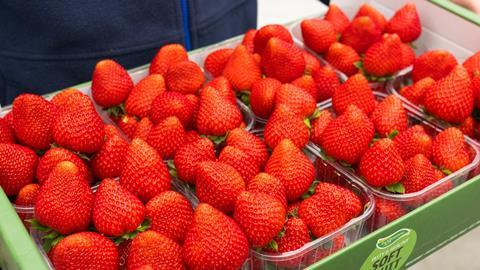
The Greenery and Botany are working on a new production model which they say could cut costs and carbon emissions without compromising quality
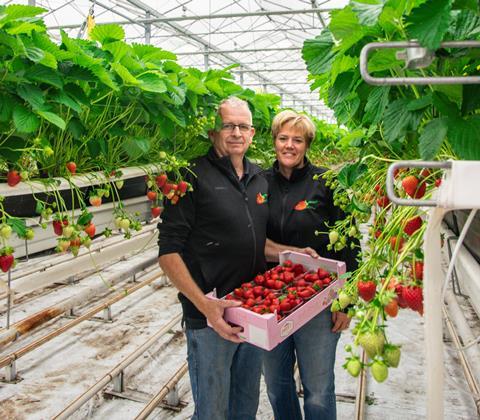
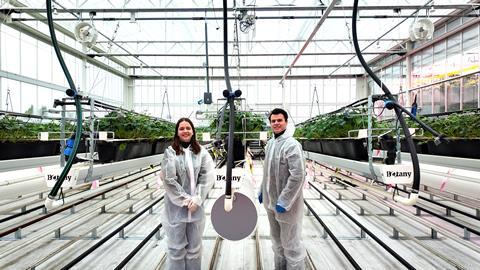
Strawberry growers Jessica and Mario Hellemons are centre forwards in a team with one shared goal – to reduce fossil inputs and maintain quality, supply reliability, and profitability.
Join us for Fruitnet Berry Congress in London – click here for more details.
At their greenhouse in the Dutch province of North Brabant, they’re trialling a low-input cultivation strategy with Inspire, a variety that’s proving increasingly popular in the Netherlands.
It’s a model that could help the country’s growers cope with higher energy costs, reduce their carbon footprint, and stay ahead of stricter market requirements.
And like all the best Dutch teams, their formation is based on a triangle. To one side, cooperative The Greenery contributes cultivation vision and expertise, as well as market and supply chain knowledge; on the other, research group Botany ‘steers’ the crop – encouraging it to produce fruit or foliage as required – and employs modern greenhouse technologies to gather a wealth of actionable data.
A smarter approach
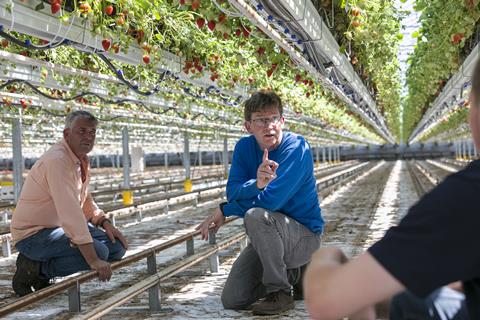
For Klaas de Jager, agronomist at The Greenery, low-input only works with the right choice of variety, climate strategy, and data-driven steering. “This isn’t a cost-cutting trick,” he says. “It’s a cultivation strategy that lets you achieve supply reliability and quality with less fossil input, and produce strawberries from early to late in the season.”
In practice, it involves a smart approach to energy. Instead of applying more heat as a standard correction, the team uses substrate heating and two screens to limit heat loss, combined with dehumidification. Steering is based on plant balance and steady production, with fewer peaks.
At the same time, supported by green crop protection, more precise water and nutrient management reduces inputs and increase the crop’s resilience, without sacrificing volume and quality.
Strong returns
As Botany’s head of cultivation, Bram Rongen, explains, the aim is that heavy, corrective interventions are needed less often. “The gains are in predictability: measure, compare, and adjust based on plant balance and climate, so you don’t constantly need to correct with extra energy.”
Genetics are a key factor too. As a low-chill variety, Inspire’s output can be maintained with a more favourable day-night regime. The fact it offers stable growth and production, predictable harvesting, and sufficient disease tolerance means there is less need for major interventions.
For Jessica and Mario, the switch to low-input was primarily a business decision, one that reduced their dependence on gas but secured strong returns. And with each square metre requiring less than seven cubic metres of gas to yield 9kg of fruit, it appears to have worked well.
As Mario suggests, the positive market response has given them confidence to expand. “Thanks to The Greenery’s support, we can steer directly on climate strategy and profitability. Inspire proves that sustainability and profit go hand in hand.”