Dutch organic importer-marketer is to expand organic mango production following a successful first full season with regional supplier Fruiteq
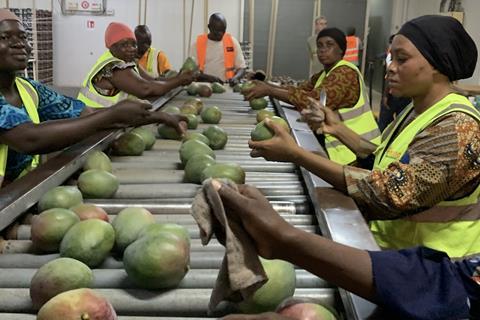
Organic fruit importer-marketer Eosta has revealed that it is planning to expand organic mango production in Côte d’Ivoire.
It follows on from a successful first full season importing from the West African country through its regional supplier Fruiteq, the group said.
The 2026 spring season followed the expansion of Fruiteq’s mango production from Burkina Faso to neighbouring Côte d’Ivoire in 2024, a move supported by Eosta.
Fruiteq, a grower-exporter based in Bobo-Dioulasso in south-west of Burkina Faso, was established in 2005 and has forged a close working relationship with Eosta since 2009.
Indeed, the relationship has seen Eosta establish a Living Wage program for Fruiteq’s seasonal mango workers.
The 2026 campaign marked the first full season that organic mango volumes were shipped from Fruiteq’s new Côte d’Ivoire operation to Europe through Eosta, following two trial seasons.
Fruiteq specialises in Amelie, Kent and Keitt, shipping two to three containers a week to Rotterdam during a mango season the runs from March to late May.
Fruiteq’s founder and managing director Zongo Adama admitted that the first Côte d’Ivoire organic mango season was complicated by the presence of fruit fly, but said the tools were now in place to ramp up production for a ”more ambitious” second full season with Eosta.
“This season has been difficult because we moved our operation to the Ivory Coast, and experienced some problems with fruit fly there for our organic mangoes,” he confirmed.
“We are expecting to do more volume next season. Our objective is to substantially increase our weekly containers and have a longer season as well.
”We already have more hectares and the grower base, and Eosta is going to help us to grow the market, so we can grow more volume,” said Adama.
His comments were echoed by Eosta product manager Joep van Koevorden.
“We have high hopes,” he commented. ”This is only the first full season we have imported mangos from the Ivory Coast through Fruiteq.
”They also have conventional fruit, but we are the only receiver of Fruiteq’s organic mangos, and they will be expanding next season.”
With ten permanent workers and up to 150 seasonal workers in the packing facility during the mango season, Eosta and Fruiteq confirmed that they take their duty of care seriously, not only to the workers but also to the wider community.
Developed in cooperation with Eosta, Fruiteq workers in Burkina Faso now benefit from receiving the Living Wage.
According to Eosta, for every box of mangos sold, it takes a few cents per kilo and puts them into a savings account. At the end of each season, Eosta deposits the savings into a community fund for Fruiteq workers.
“People working at Fruiteq, if they have a good business plan, they can borrow money from that fund to start their own business to maintain themselves financially outside of the mango season, which is quite short – it’s only two months a year,” explained Van Koevorden.
Adama added: “The Living Wage project has been very successful. After the mango season, together with Eosta, we give the money that has been saved to the workers’ association – some of them are able to use it for their own businesses, which has been very positive.
They are able to work for themselves, and don’t need to do seasonal work again. It’s been a very good project with Eosta.”
Although the system is not yet in place in Côte d’Ivoire given that operations are still relatively new in the country, Eosta added that plans are already in motion to set it up.


