Industry body Freshuelva says persistent rainfall during early development stage limited availability of fruit this season
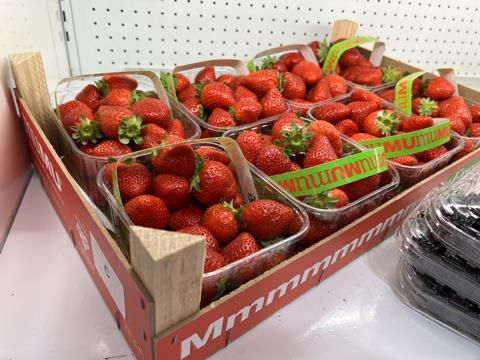
Freshuelva, which represents strawberry producers and exporters in the Spanish province of Huelva, says a series of storms in early 2026 had a direct impact on sales to international markets because a lower volume of fruit was available.
In an assessment of the 2025/26 season, it said foreign trade data up to May showed that the region’s strawberry crop was 3 per cent smaller at 204.305 tonnes.
“The continuous rains during key stages of crop development particularly affected the volume sold, reducing product availability for much of the season,” it commented.
Conversely, raspberry production closed the season with 5 per cent growth to 39,545 tonnes, while blackberry production registered the largest percentage increase of all berries – albeit from a low base – with 2,517 tonnes, 33 per cent more than the previous season.
Blueberry production, meanwhile, was also affected by adverse weather conditions for much of the season, and ended 6 per cent down on the previous year at 59,500 tonnes.
As a result, exports were down on the previous year for strawberries (down 3.3 per cent to €675.7mn), raspberries (down 3 per cent to €222.7mn), and blueberries (down 4 per cent to €336.2mn).
The export sales trend for blackberries was positive, however, with 12 per cent growth to €20.6mn.
Destination Europe
According to Freshuelva, Germany remained the province’s primary market for strawberries, raspberries, and blueberries.
For strawberries, the UK and France made up the top three destinations, while for raspberries second and third spot went to the UK and the Netherlands respectively.
The Netherlands and France were right behind Germany as Huelva’s lead blueberry destinations, and for blackberries, the main destination was again the Netherlands, followed by Germany and France.
“Freshuelva believes that the season has once again demonstrated the adaptability of a sector that has responded to particularly adverse weather conditions, maintaining its commitment to the highest standards of quality and food safety, varietal innovation, and supplying international markets despite the difficulties experienced for much of the year,” said a spokesperson.
The association also emphasised a need to continue making progress on strategic issues that affect the sector’s competitiveness, such as water availability and hydraulic infrastructure, workforce stability, soil disinfection, and ensuring a level playing field against imports from third countries.
“In this regard, Freshuelva again calls for the promotion of reciprocity mechanisms, such as mirror clauses, that guarantee that imported products meet the same social, labor, phytosanitary and environmental requirements demanded of European producers.”