Many more people in the UK will be unable to afford fresh fruit and vegetables by 2050, the Autonomy Institute states, as heat waves alone are expected to add 68 per cent to the price of a grocery basket
Climate change is set to make fresh fruit and vegetables unaffordable for many within the next two decades, according to a report by the independent research organisation, the Autonomy Institute, as extreme weather disrupts production both at home and abroad.
Heat waves alone are projected to add around 11 per cent to the price of the UK’s top 20 fruit and vegetables by 2035, the report reveals, and around 68 per cent by 2050 under a high-emissions scenario. Under a low-emissions scenario, the basket-wide figure stands slightly lower, at around 8 per cent by 2035.
The estimates are on top of inflation, and do not factor in other climate-related impacts like flooding, damage to infrastructure, soil erosion and degraded water quality.
According to the research, imported tropical fruits like melons, oranges, bananas, easy peelers and grapes are predicted to rise by 12-14 per cent by 2035, and by 80-93 per cent by 2050, solely due to climatic factors.
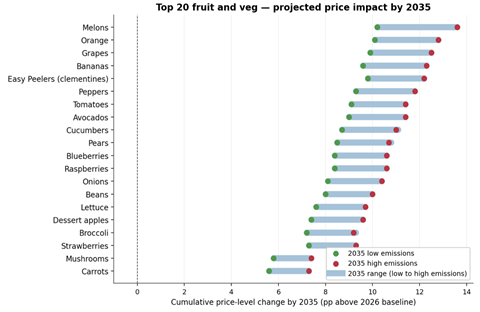
UK-grown staples including carrots and mushrooms will be more insulated from the effects, but are still forecast to see prices rise by around 7 per cent.
“Compounded with estimated normal inflation, total average shelf prices of the overall basket of fruit and veg will reach upwards of 170 per cent above today’s level by 2050,” the report, titled ‘The Price of 5 a Day’, stated.
This means that “climate-flation” will contribute 40 per cent of total inflation across a basket of basic goods by 2035, and over 60 per cent of inflation by 2050.
“The report makes it clear that a state strategy for reducing prices is needed to maintain affordability through the period in which climate factors are still rising,” the Autonomy Institute stated. “Later studies by Autonomy will explore price caps, domestic horticulture investment, low-carbon greenhouses and a serious industrial strategy for resilient food supply.”
A response to food inflation needs to start now, the organisation urged, “not when plateauing or negative wage growth fails to counter the cost of healthy essentials in the years ahead”.
Worrying, the Autonomy Institute stressed that the report remains a conservative estimate, since it does not factor in geopolitical impacts on inflation, frequently driven by climate and resource factors.
The organisation also warns that such food inflation remains “locked in”. “It’s important to note that climate-attributable food inflation is not cyclical: unlike supply-chain or energy spikes it does not unwind,” the report stated. “Each year that emissions remain on the current trajectory adds to the locked-in component.”