

The country’s fruit exports have grown steadily over the past decade and surged in 2025, as Wayne Prowse reports
Best known for its vibrant carnivals, passionate football culture, the vast Amazon Rainforest and iconic beaches, Brazil’s extraordinary biodiversity also underpins one of the world’s most significant fresh produce industries.
This natural resource supports a vast domestic market of 212mn consumers, but it is also behind some steady growth in the country’s global export markets.
Brazil is the world’s third-largest producer of fresh fruit, behind China and India.
In 2024, its production reached an estimated 44mn tonnes, dominated by oranges, bananas and mangoes.
Spanning tropical, subtropical, and temperate climatic zones, the country’s diverse geography means it can grow an exceptionally broad range of fruit varieties.
And while its fresh produce industry remains predominantly focused on the domestic market, export momentum is building.
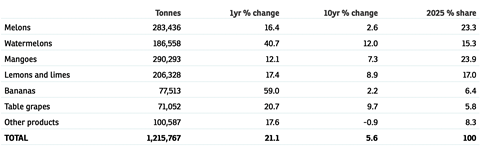
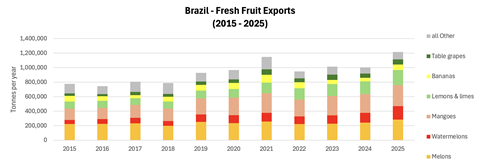
Volumes have increased at an average of 5.6 per cent per year over the past decade, and surged by 21 per cent in 2025 to 1.2mn tonnes.
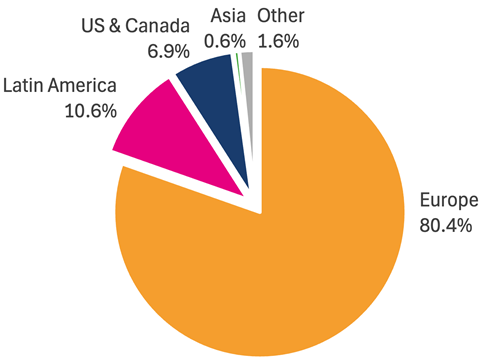
Melons, mangoes and limes make up the bulk of export volumes, with Europe absorbing more than 80 per cent of those shipments.
Regional markets in Latin America, led by Argentina and Uruguay, take a further 11 per cent, while the US and Canada together account for around 7 per cent.
As production systems modernise and logistics continue to improve, Brazil’s export footprint is well positioned to expand further from an already formidable production base.

Melons and watermelons
Melons, including watermelons, led the export offer in 2025 with 470,000 tonnes, up 25 per cent year on year.
Watermelons were 40 per cent of the combined melon volume, and rose 41 per cent.
Cantaloupe and other types accounted for 60 per cent of the volume, which was 16.4 per cent higher on the year.
European markets received 93 per cent of Brazil’s melon exports, with the US, Canada and Argentina taking most of the remaining 6 per cent.
Although European demand dominates and has grown steadily at 5.1 per cent per year, annual growth in the US, Canada and Latin American markets combined has exceeded 12 per cent over the past ten years, which has served to reduce the country’s reliance on European demand.
Brazil’s primary melon production areas are concentrated in semi-arid regions of north-eastern states that are recognised for year-round cultivation, with an ideal climate for sugar development enabling high-quality export development.
Variety expansion into seedless and mini watermelon varieties is also helping export growth.

Mangoes
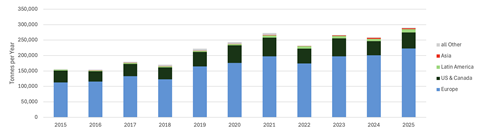
Mangoes are Brazil’s single biggest fresh produce export. The trade has expanded 5.7 per cent per annum in ten years, to 290,000 tonnes in 2025.
Around 77 per cent is destined for Europe, where Brazil is the largest supplier, and a further 18 per cent goes to the US and Canada.
Brazil’s mango production areas are also mainly in the north-east, particularly the São Francisco Valley – it dominates exports due to good irrigation and favourable climate, which allow for year-round supply to export markets.

Limes
Brazil has developed its capacity as a leading exporter of limes. In 2025, the country exported 206,000 tonnes of the fruit, 17 per cent more year on year and up 9 per cent per year over the decade.
About 92 per cent, or 190,000 tonnes, were Europe-bound, where Brazilian limes accounted for around 80 per cent of total lime imports.
Interestingly, of the 17mn tonnes of oranges produced in Brazil, around 85 per cent are used to make orange juice, and most of the balance is consumed in its domestic fresh markets, with less than 1,000 tonnes exported.