Sustainability, convenience and added value topped the agenda as three berry packaging specialists shared the Fruitnet Berry Congress stage in London
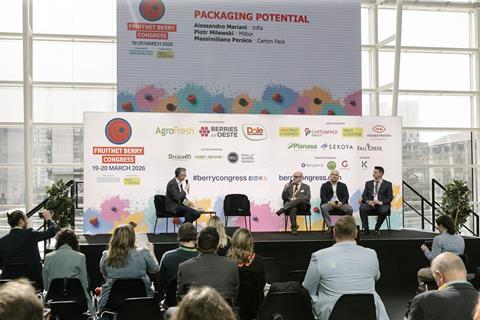
At this year’s Fruitnet Berry Congress, which took place in London on 19-20 March, a special brainstorming session saw three berry packaging business leaders take a whistlestop tour of the big challenges around cost, environmental impact, and regulatory compliance.
Hosted by Eurofruit’s Mike Knowles, the session brought together Infia’s Alessandro Mariani, Piotr Milewski of Milbor and Carton Pack’s Massimiliano Persico to ponder all things packaging.
Packaging is so important for berries and is an essential part of the supply chain. What will consumers want from their packaging in future? Will it be convenience, bigger sizes, or different materials?
Alessandro Mariani: At the top of our list is customisation. That means bringing a greater number of customised options for different people’s needs. These include snack packs, bigger sizes or family packs, convenient packs and super-value packs.
Piotr Milewski: I agree with Alessandro, in that we are seeing split demand. On one side there is convenience, like shaker cups or even school snacks, but on the other side inflation is driving up cost which leads to greater demand for family-size packs. I think there is room for both, but at the end of the day we need to make sure that we gain shelf space as a category and there is no one-size-fits-all scenario.
Massimiliano Persico: My colleagues are right. There are two diverging extremes, the first being snacking on-the-go – so convenience – and the other one is the bulk family pack that was mentioned, so bigger sizes.
What is happening within convenience that makes it so interesting as a packaging format?
MP: Snacking on-the-go, and all the options that you have there, is the category that is innovating the most at the moment. You have closable systems with lidding films, different closing mechanisms and more, so convenience is the place there are more developments.
PM: You also have different specialty occasions that packaging can be tailored to. You will have seen recently for Valentine’s Day, you have things like unique heart-shaped berry punnets and other styles.
AM: If we were to look at new areas to sell, such as airports, packaging would need to be more ready-to-go. You would have more snack packs that offer a particular attraction, and they would have to be resealable.
Let’s move on to sustainability. These new packs that you are designing, part of the formula is to use fewer materials. How is that changing your packaging?
AM: There are two points. The first is that the design needs to be done in line with recyclability. So your packaging must be designed in a way that it can be recycled by machinery. The second point is weight reduction, as much as possible, until you meet the minimum threshold in terms of affecting the shelf-life of the product. If you start to lose out on shelf-life of berries, the carbon footprint then explodes.
Is the rate of development accelerating when it comes to material research and change?
PM: It is not only about the materials but also about the structural engineering of the packaging. You must consider, on one hand, how to produce it with less material, while on the other hand still protecting the fruit, because we are also talking about a very delicate fruit. I would also like to bring the perspective of the packers and growers because we all complain about labour, we need to automate, and in order to automate we also need to have good quality, consistent packaging, not flimsy punnets. It’s a very big headache.
What are the incoming EU PPWR regulations doing to the berry packaging business?
MP: It’s affecting the business, of course, because it is a regulation that is strictly for those involved in the European market. The deadline is coming up in August this year, and it means that we have to rethink our packaging again, in terms of compliance. Quite simply there is no way out, which is why we are strongly moving towards eco-design. Moreover we are thinking about hybrid solutions, because you can decrease the plastic content but at the same time use other material options and mesh them together to create something new.
Are these hybrid options permitted in the EU under the new regulations?
AM: There are two areas that need to be clear here. Firstly, in 2030 there will need to be a minimum of 30 per cent recyclable material included in the packaging, and in 2040 this goes up to 40 per cent – but we are all almost there already. Secondly, they say that you can pack fruit if it is over 1.5kg. We don’t have to be afraid, however, because In 2027 they are going to issue a list of exceptions in which I am 99.9 per cent sure all kinds of berries will be included.
Has this enforcement of these PPWR rules by Brussels actually made the packaging industry better? Has it been a good experience overall?
AM: Yes, but it does depend on what you pack. The target is a good target, but it will affect two companies, two competitors, different based on what is being packed.
Let’s finish on added value. Where do you see new opportunities to add value on berry packaging, that will be beneficial to the rest of the supply chain?
PM: We know that packaging is no longer just a vessel for the fruit and that it can be actively used to promote a brand. We can think about active packaging that increases shelf-life, or smart labels with QR codes that shows the story of the farm, the product, or provides instant recipes to the consumers. Basically it is a way to sell a brand rather than a commodity, and you can see that at this congress – a lot of companies are already doing that.
MP: I agree with Piotr. We have a project called Sunrise 2027 which gives us the option to create more branding on the packaging and use the QR code to tell a story and create more consumer engagement – it’s a big opportunity.